


sections.accessibility.skip_to_content

Rolife Corner Bookstore DG164 Buyer Guide: What to Know Before You Build

Aug 08,2026 | Rolife Team

Quick Answer

Corner Bookstore DG164 is a strong choice for a book lover who wants a freestanding miniature shop and is willing to spend about five hours on shelves, books, furniture and fine decorative details. Its 3/5 difficulty is manageable for a patient beginner, but “108 pieces” understates the experience: the tiny books and telephone wire can demand more concentration than the outer structure.

Choose it for the bookshop atmosphere and personalization potential. Choose something faster if you dislike repeated paper details, fine wire or projects that may extend beyond one sitting.

Corner Bookstore DG164 at a Glance

DetailCorner Bookstore DG164
Difficulty3/5
Piece count108 pieces
Estimated assembly timeAbout 5 hours
Assembled size9.8 x 6.5 x 7 in / 25 x 16.7 x 18 cm
Scale1:20
FormatFreestanding miniature shop, not a narrow book nook
Main appealBookshelves, miniature books, typewriter, telephone, furniture, plants, and a broad bookstore interior
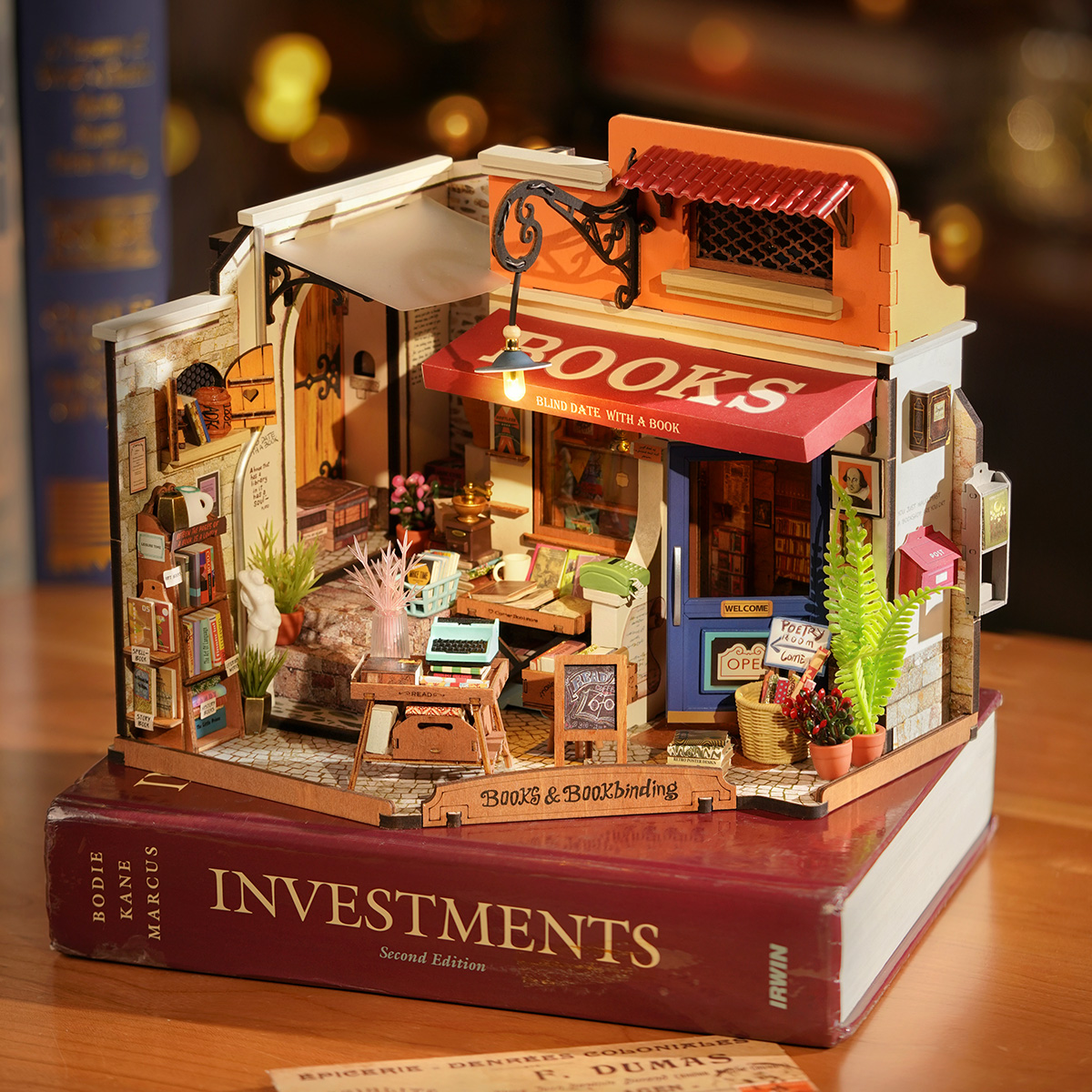
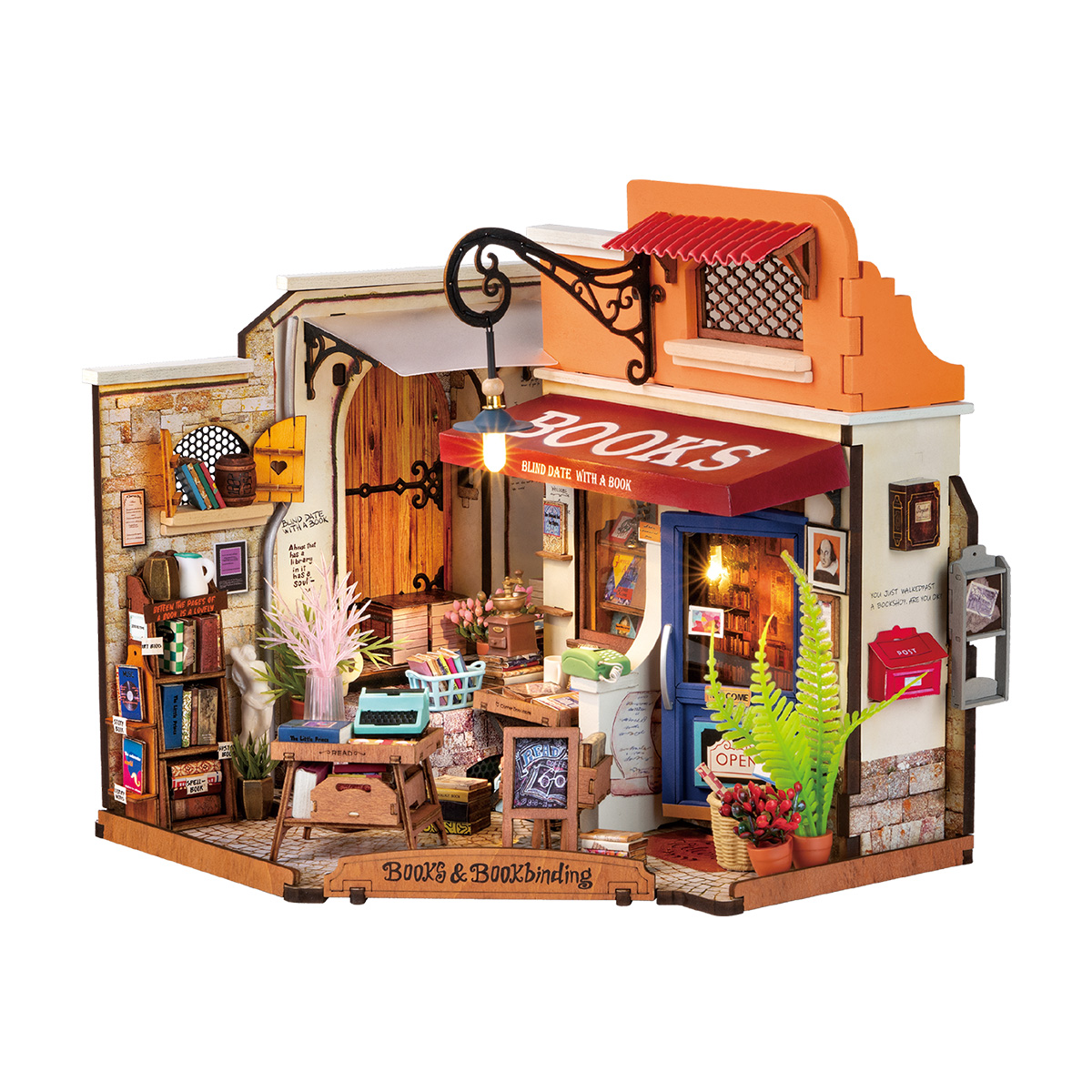
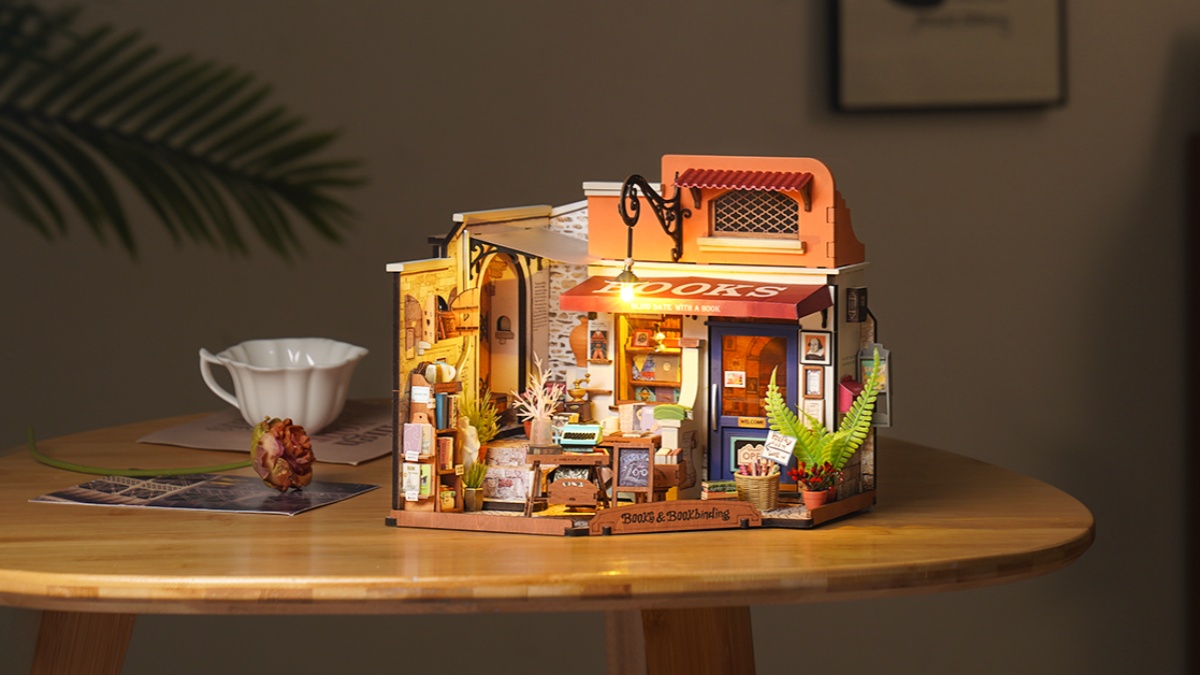
Completed Rolife Corner Bookstore DG164 freestanding miniature bookshop
Corner Bookstore DG164 opens the whole shop to view, making its shelves, furniture, and tiny reading details part of the display.

Is Corner Bookstore Right for You?

You will probably enjoy it if...You may prefer another kit if...
You enjoy bookstore details and miniature storytelling.You want the fastest possible first build.
You want a freestanding scene that can sit beside books.You specifically want a narrow insert that sits between books.
You like a mix of structure, furniture, and decoration.You dislike repeated paper details.
You want a recognizable base for personal covers, posters, and signage.You prefer a short snap-fit experience.
You have a stable surface and can handle delicate pieces patiently.Fine wire and fragile decorative parts tend to frustrate you.

What Does the Build Actually Ask You to Do?

The difficulty is not evenly distributed. Think of DG164 as five different mini-projects.

1. Establish the bookstore structure

The walls and major surfaces create quick early progress. This stage feels reassuring, but accuracy matters: an orientation error can make later shelves or fittings seem misaligned.

2. Build the furniture and shelves

The shop becomes recognizable here. Dry-fit parts before securing them and keep the front viewing angle in mind. A clean shelf line matters because the eye reads the books as a repeated pattern.

3. Make the miniature books

This is the commitment hidden by the 108-piece count. Each book is small, but the bookstore needs many of them to feel convincing. Builders who enjoy paper detail may find this the most thematic stage. Builders who expected mainly structural assembly may find it the slowest.

4. Shape the character details

The telephone, typewriter, plants and signs stop the room from feeling like an empty set. The telephone wire deserves particular care: form it gradually and avoid repeated sharp bends.

5. Align and finish the whole scene

Before final placement, view the model from the front and slightly above. Correct tilted books, visible adhesive or blocked details while access is still easy. The broad front is the main display advantage of this kit, so final sightlines matter.

Corner Bookstore DG164 interior details with miniature shelves and furniture
The bookstore's character comes from the accumulation of small details, especially its shelves, books, signs, and furniture.

Three Real Builder Perspectives

Community builds show why a single difficulty label cannot describe every experience. The same kit can feel charming, demanding, or deeply personal depending on pace, handling style, and customization goals.

Rolife Community Maker: Pola

Creation
Corner Bookstore as her fifth Rolife build and her first project with this many miniature books.

What she changed
She slowed down to read the book titles and paid close attention to the telephone and typewriter details.

What to learn
The book-making stage creates both the charm and the workload. The telephone wire is a small component with a need for extra patience.

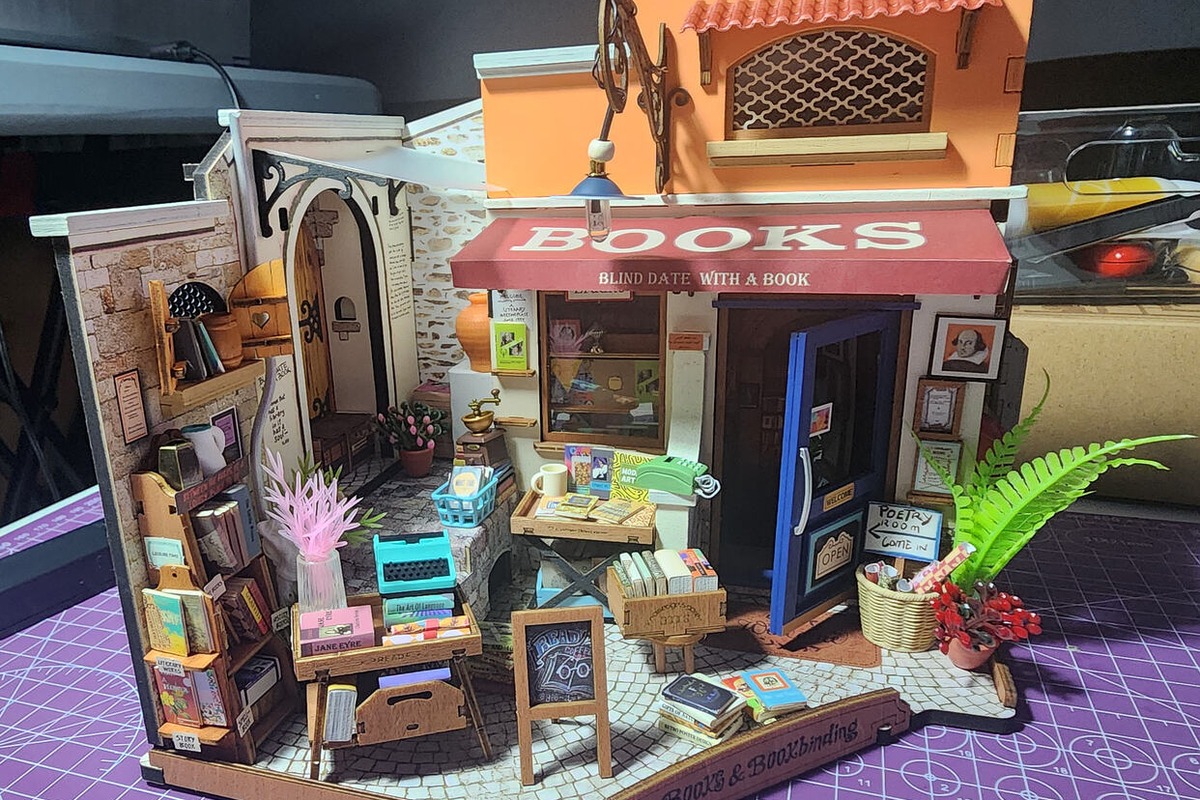
Pola's completed Corner Bookstore DG164 community build with books and miniature shop details
Pola's Corner Bookstore DG164 community build. Photo shared in the Robotime community.
“It wasn’t the easiest kit since it was my first time making this many books.”

Read Pola's original Corner Bookstore post.

Pola later added, “I had a hard time with the telephone wire. Haha! But this kit is cute. The books looks real.” That sentence is a useful buying summary: DG164 succeeds because the detail looks convincing, but some of that realism has to be earned through fine handwork.

Rolife Community Maker: Wendy

Creation
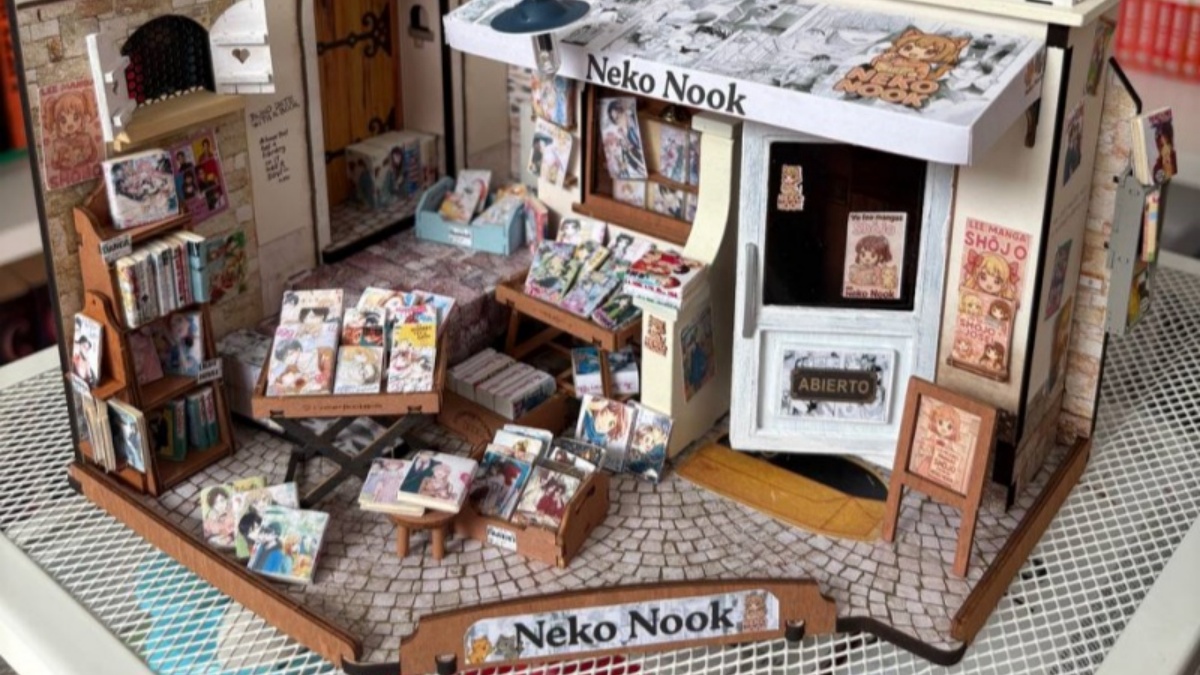
“Neko Nook,” a manga version of Corner Bookstore built around favorite volumes and anime memories.

What she changed
She renamed the store, painted a catgirl on the canopy, replaced general books with manga covers and added anime posters.

What to learn
The bookstore is a flexible narrative base. A strong customization plan does not require changing the structure; signage, covers, posters and selected colors can make the standard shop personal.

Wendy's customized Neko Nook manga bookstore based on Corner Bookstore DG164
Wendy transformed Corner Bookstore DG164 into Neko Nook, a miniature manga shop filled with favorite volumes and anime memories.
“When I built Corner Bookstore DG164 as Neko Nook, I did it with the idea of turning it into a manga shop that included my favorite volumes, so I could keep them as a little mini memory forever.”

Read Wendy's Neko Nook user story.

Wendy displayed the finished model in her study and said, “Every time I walk into my study, I can’t help but look at this kit with great fondness.” Her case shows why display planning belongs in the buying decision: the emotional value comes from seeing the personalized object repeatedly, not only from completing it.

Rolife Community Maker: JeanneL

Creation
A completed Corner Bookstore shared as a contrasting experience in the same community discussion.

What she changed
Her comment focused on the build difficulty rather than customization.

What to learn
One successful beginner experience does not make the kit universally easy. Builders who tend to force or repeatedly handle delicate parts should slow the process and leave room for careful adjustments.

“I kept breaking things left and right. In the long run I liked it but through the process, No!”

See JeanneL's comment in the Corner Bookstore discussion.

The contrast between Pola and JeanneL is more useful than a simple “beginner-friendly” label. Both could appreciate the result; their experience differed because fine detail and fragility interact with individual pace and handling style.

Is It Beginner-Friendly?

Yes for a patient beginner, but not for every beginner.

A good first-time buyer for DG164:

  • is comfortable working for several hours or across two sessions
  • likes books enough to enjoy repeating miniature covers and shelves
  • can shape fine details without rushing
  • will stop and check orientation instead of forcing a part
  • has a stable, well-lit workspace.

A beginner who wants quick fitted assembly should first try a one-hour Super Creator room. A beginner who specifically wants a bookshelf insert should choose a book nook rather than assuming a bookstore-themed miniature serves the same display purpose. For more help, see How to Choose a Beginner-Friendly Miniature Kit.

How Should You Plan the Five Hours?

Do not treat the estimate as one uninterrupted deadline. A more realistic plan is:

  1. Session one: inventory, instructions, main structure and shelves.
  2. Session two: books, furniture and shop details.
  3. Session three: telephone wire, plants, alignment, cleanup and display.

An experienced builder may combine these stages. A first-time builder may need longer. Custom book covers, painted signage or careful photography can extend the project without indicating a problem.

How Can You Personalize Corner Bookstore Without Making It Harder?

Wendy's Neko Nook offers a practical sequence from lowest to highest commitment:

  1. Rename the shop. Change the sign or canopy before assembly blocks access.
  2. Replace selected book covers. Use titles with personal meaning rather than redesigning every shelf.
  3. Add wall posters. Flat graphics create a strong theme without affecting fit.
  4. Choose one accent color. Repeat it on signage, trim or a small object.
  5. Add a story object. A favorite genre, character or memory is more coherent than many unrelated decorations.

Keep tabs, slots, moving areas and structural edges clear. Personalization should add meaning, not create a fit problem.

Rolife Corner Bookstore DG164 miniature bookstore ready for personal details
Book covers, posters, signage, and a restrained accent color can personalize the shop while preserving its original structure.

Corner Bookstore or a Bookstore Book Nook?

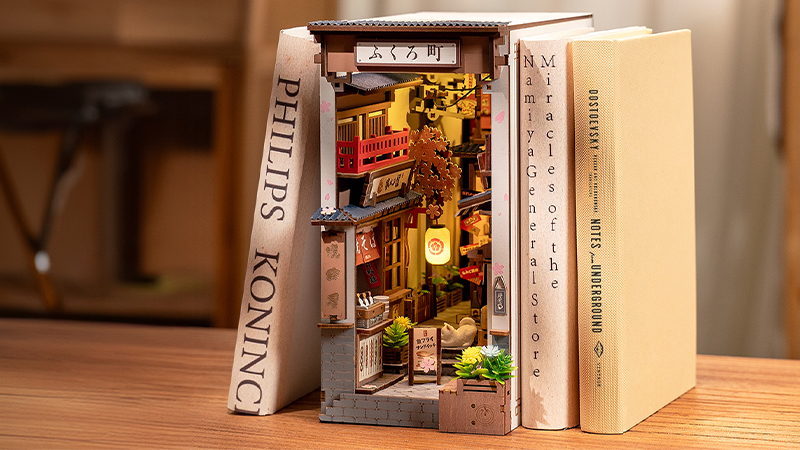
Corner Bookstore DG164 and Bookstore TGB07 share a bookshop theme, but they solve different display needs. DG164 is an open, freestanding miniature with a broad front. TGB07 is a narrow bookshelf insert that uses the books around it as part of the scene.

Decision pointCorner Bookstore DG164Bookstore TGB07
Display formatBroad front, freestanding shopNarrow insert between books
Creative accessOpen interior with room to customizeFramed, tunnel-like perspective
Space planningNeeds a 25 x 16.7 cm surface plus clearanceNeeds compatible shelf height and depth
Best placementBeside books, on a desk, or in a cabinetBetween books where the shelf completes the display

Browse the Book Nook collection if the bookshelf-insert format is the priority, or read Book Nook vs Miniature House for a format-first comparison.

Rolife Bookstore TGB07 book nook displayed as a narrow bookshelf insert
Bookstore TGB07 is the better match when the scene needs to live between books rather than beside them.

Measure the Display Before You Build

The model is 25 cm wide, 16.7 cm deep and 18 cm high. Add working clearance rather than matching the dimensions exactly.

  • Leave room above to lift the model without catching details.
  • Keep the front unobstructed; the bookstore depends on a broad view.
  • Allow a little side space for safe dusting and movement.
  • Decide whether a display box will fit the model and any personalized signage.
  • Place it where the book titles and interior can be viewed, not only the facade.

What to Prepare

  • A flat, bright workspace that can remain undisturbed.
  • A tray for books and small decorative parts.
  • Fine tweezers or the tools specified in the current instructions.
  • A place to set shaped wire without flattening it.
  • A method for keeping book covers and shelves grouped by step.

Keep the DG164 assembly instructions and parts support guidance close at hand.

Confirm adhesive and tool requirements in Do Rolife Kits Require Glue? and What Tools Do I Need for Rolife Kits?.

Frequently Asked Questions

How difficult is Corner Bookstore DG164?

Rolife rates it 3/5. The structure is moderate, while repeated books, fine wire and delicate details create the patience requirement. It is achievable for a careful beginner who wants a detail-rich first project.

How long does Corner Bookstore take?

The estimated assembly time is about five hours. First-time learning, multiple sessions, custom covers or slow detail work can extend it.

Why can 108 pieces still feel detailed?

Piece count does not fully represent repeated paper work or the concentration required by small decorative parts. The books and wire are the clearest examples in DG164.

Can I turn it into a manga shop or personal bookstore?

Yes. Wendy's Neko Nook demonstrates a low-risk approach using a new shop name, custom book covers, posters and selected painted details while retaining the original structure.

Is Corner Bookstore a book nook?

No. It is a freestanding 1:20 miniature shop. A book nook is normally a narrow insert designed to sit between books.

What should I do if a part keeps breaking or does not fit?

Stop applying force, confirm the part number and orientation and review the previous step. Use Rolife replacement support for a genuinely damaged component rather than hiding a structural problem.

Key Takeaway

Corner Bookstore DG164 is worth choosing when the books are the point, not merely the background. Its five-hour, 3/5 build combines a manageable structure with repeated book details and a few fine-handling stages. The same design can become a standard cozy bookstore or a deeply personal “Neko Nook,” but the buyer should want both the finished shop and the patient work that makes it believable.

View Corner Bookstore DG164

The Rolife Edit

A Little More Creativity in Your Inbox

Get new miniature releases, building inspiration, thoughtful gift ideas, and occasional Rolife offers.

Comment

Name
Email
Comment