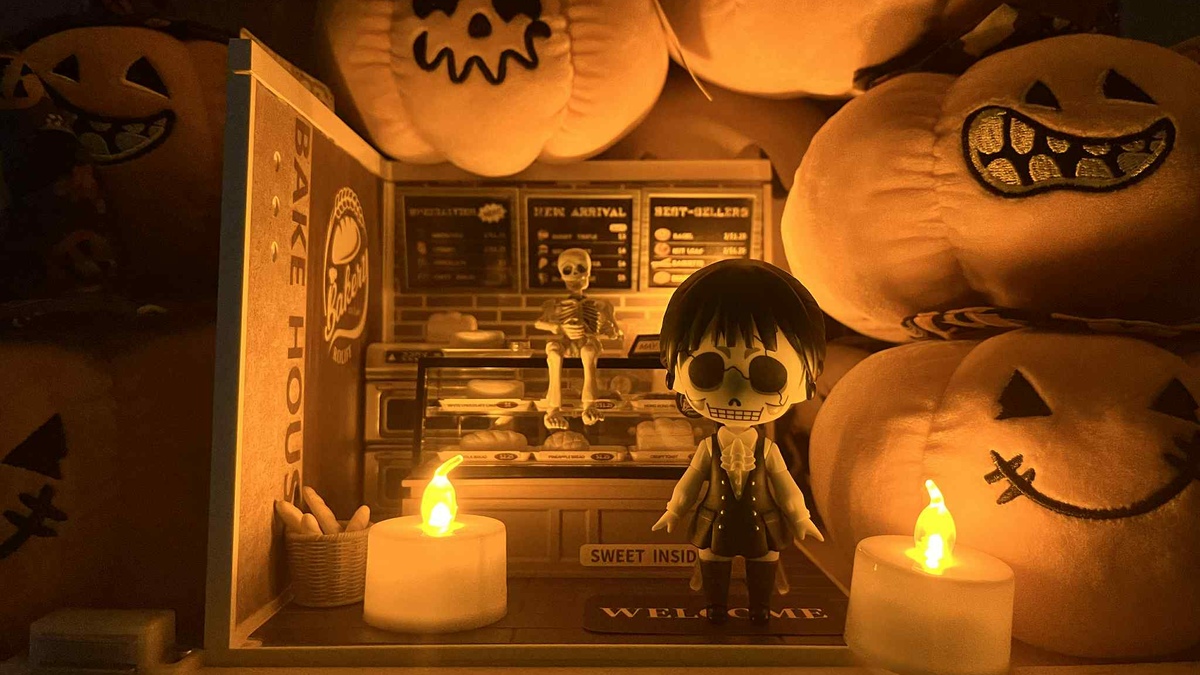


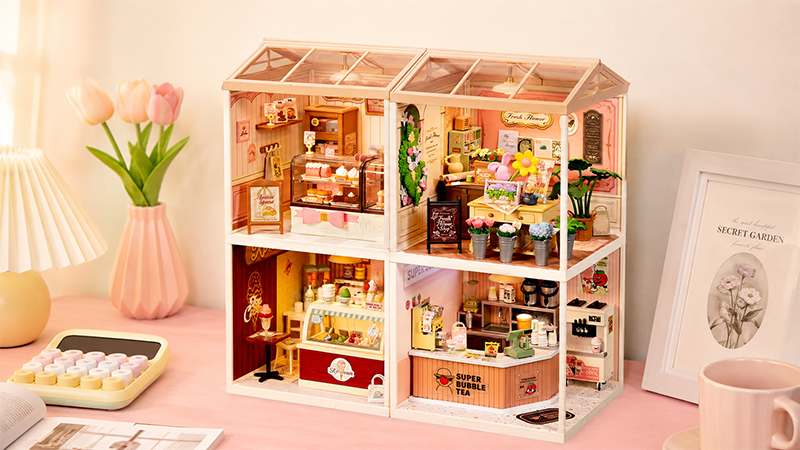
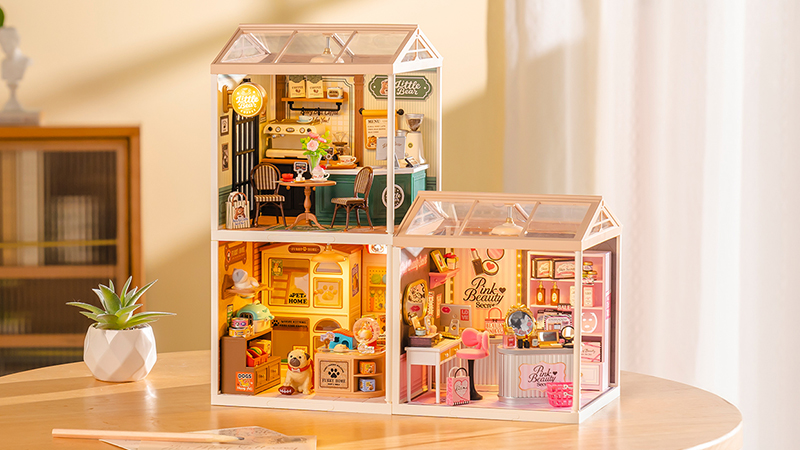


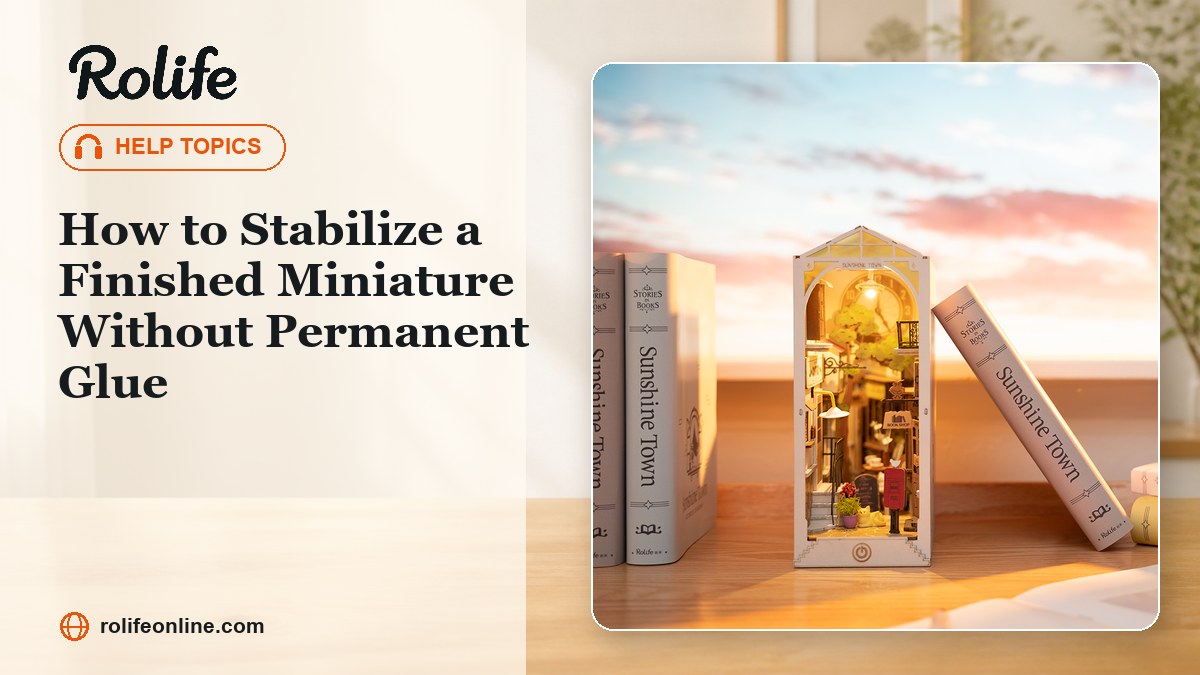
A finished miniature should feel secure without becoming permanently attached to the furniture beneath it. The safest solution depends on the actual problem: sliding, tipping, an uneven base, loose internal pieces, or a shelf that is regularly bumped.
Which Rolife Displays May Need Extra Stability?
Depending on your display setup, some finished Rolife scenes may benefit from an extra non-permanent support. This does not mean every kit has a stability problem; the need usually comes from shelf depth, surface finish, foot traffic, nearby objects, or how often the display is handled.
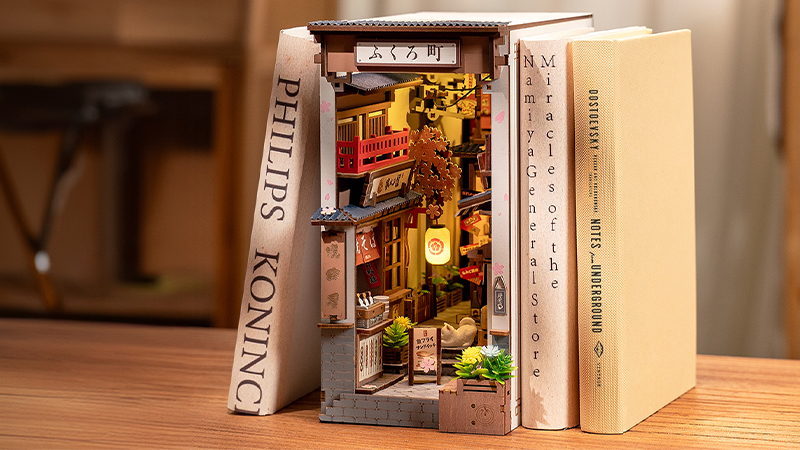
- Book nook kits displayed between books, especially when neighboring books are moved often.
- DIY miniature house kits displayed on desks or open shelves that may be bumped during daily use.
- Larger finished miniatures displayed in open cabinets where the full base needs even support.
- Lighted kits where the switch or battery compartment must remain reachable after the model is secured.
- Seasonal displays that may be moved, rotated, or restyled several times a year.
Choose the support around the real display risk. A stable model on a level, protected shelf may not need anything beyond careful placement.
Which Stabilizing Method Fits the Problem?
| What is happening? | Start with | Why it helps |
|---|---|---|
| The model slides on a smooth shelf | Thin non-slip mat or shelf liner | Adds friction without attaching the model |
| The base rocks on an uneven surface | Level the shelf or add a rigid flat board | Creates full, even support under the footprint |
| The model is narrow or top-heavy | Removable tray or wider base with a low lip | Increases the effective footprint and catches small movement |
| Light vibration shifts the model | Tiny tested points of removable display putty or gel | Adds temporary hold while allowing later removal |
| Books or objects bump a book nook | Hidden side stop, spacer, or fitted shelf position | Prevents lateral movement without squeezing the model |
| Pets, children, or busy traffic create impact risk | Enclosed case or a less accessible shelf | Reduces contact instead of relying only on adhesive |
What Should You Check Before Adding Any Support?
- Test the shelf itself. Press lightly at each corner and check whether it rocks, bows, or slopes. Stabilizing the model will not fix unstable furniture.
- Inspect the miniature’s footprint. Look for protruding wires, feet, trim, or dried adhesive that prevent the base from sitting flat.
- Check internal parts. A loose wall, roof, battery box, or decoration can make the model feel unstable even when the base is secure.
- Plan access. Keep switches, battery compartments, removable roofs, and cleaning points reachable.
- Identify the surface finish. Paper, fabric, unsealed wood, fresh paint, and delicate coatings need more caution than a broad sealed base.
Simple Display Stability Checklist
Before adding a mat, stop, tray, or temporary contact point, run through this quick check:
- Is the shelf level and structurally stable?
- Is the miniature’s entire base fully supported?
- Is the model positioned away from the shelf or desk edge?
- Can you still reach the switch, battery box, removable roof, or cleaning points?
- Are pets, children, doors, books, or frequently used objects likely to touch it?
- Does the proposed support touch delicate paper, fabric, paint, printed panels, or unsealed wood?
- Can the model still be removed safely for cleaning, repair, storage, or restyling?
What Is the Safest Order of Solutions?
Work from reversible environmental changes toward limited-contact supports. Stop as soon as the miniature is stable enough for normal use.
- Choose a level, low-vibration location. Move the model away from doors, speakers, unstable cabinets, and the edge of a frequently used surface.
- Add a non-slip barrier. Cut a thin mat slightly smaller than the model’s footprint so it stays hidden.
- Use a rigid removable base. A flat board, acrylic base, or shallow tray supports the whole model and makes cleaning or moving easier.
- Add a hidden stop. A low lip, shelf spacer, or backstop can prevent travel without touching decorative surfaces.
- Consider minimal removable putty or gel. Use only if the product instructions allow both surfaces and a hidden spot test shows no change.
- Use a display case for higher risk. An enclosure protects against contact and dust while keeping the model independent from the shelf.
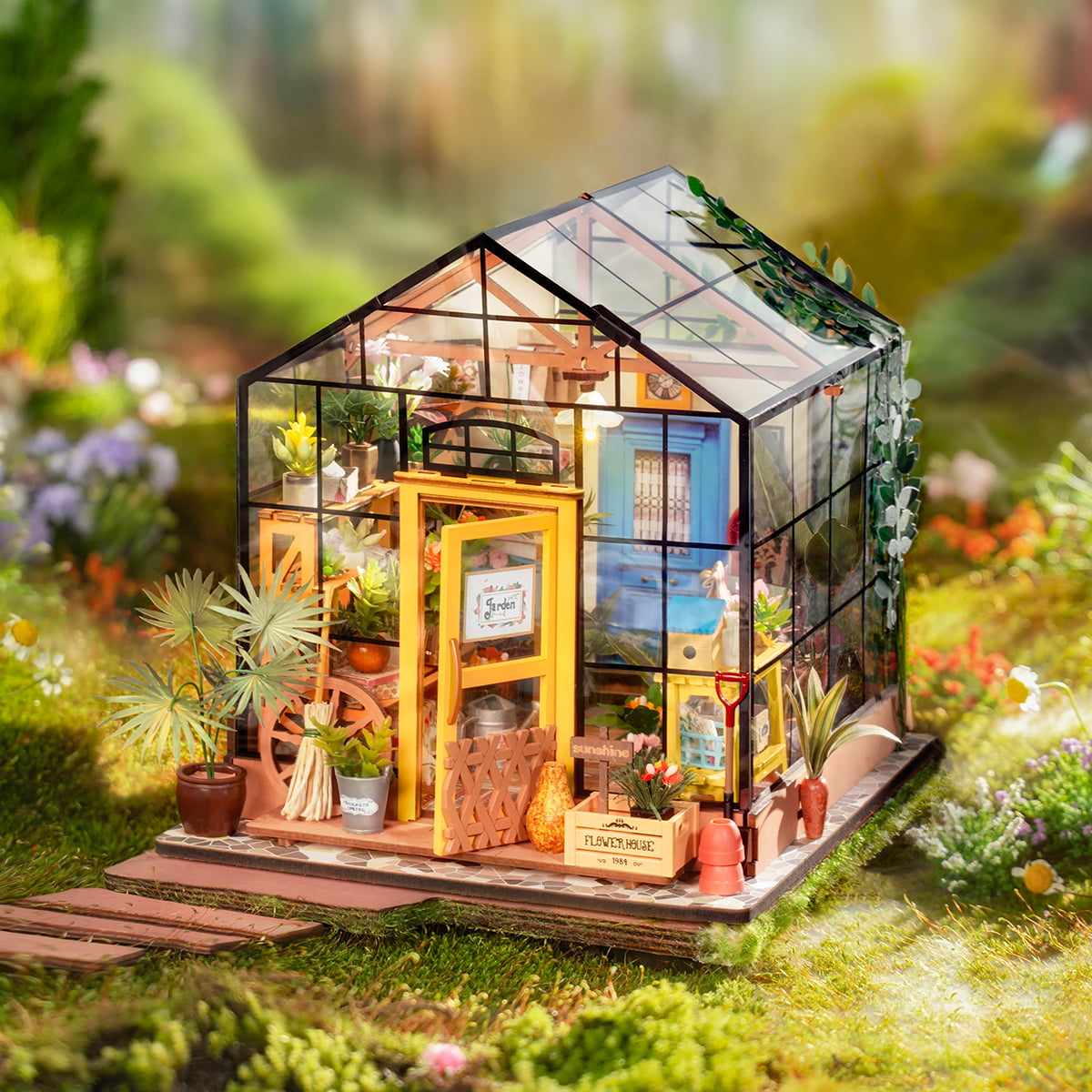
View Cathy's Flower House DG104. The support method depends on the actual display surface and is not included in the product image.
How Do You Use Removable Putty or Gel More Safely?
Removable does not mean compatible with every material. Some products can leave oil, color, residue, or a pressure mark, especially on porous or delicate finishes. Read the product instructions and use a physical support instead when compatibility is uncertain.
- Test a tiny amount on a hidden, non-decorative area and leave it for the recommended test period.
- Avoid direct contact with paper, fabric, unsealed wood, freshly painted surfaces, or fragile printed decoration unless compatibility is confirmed.
- Use a few very small points under a broad, structurally sound area; do not cover the whole base.
- Keep the material away from switches, battery compartments, lighting wires, and ventilation openings identified by the product manual.
- To remove the model, support its base and use a slow, gentle twisting motion rather than pulling on the roof or decorative walls.
- Inspect the contact points periodically and replace the material if it becomes dirty, hard, oily, or difficult to remove.
How Can You Stabilize a Book Nook on a Shelf?
Measure the finished width, height, and depth before choosing the shelf position. Place the book nook fully on the shelf rather than letting part of its base overhang. A thin non-slip mat can reduce sliding, while a removable spacer or low side stop can keep neighboring books from pushing it sideways.
Books can provide light visual framing, but they should not clamp the book nook tightly or block a switch or battery compartment. If the shelf is deeper than the model, a separate backstop can keep the display aligned with the book spines without gluing it to the furniture.

View Sunshine Town TGB02. Measure the shelf and leave the model fully supported rather than relying on pressure from the books.
How Should You Stabilize a Miniature for Cleaning or Moving?
A removable base or tray is useful because you can move the support and miniature together. Before lifting, clear the destination, secure or remove loose exterior accessories, and support the main base with both hands. Do not lift a miniature by its roof, handle-like decoration, lighting cable, or acrylic cover unless the product instructions say that part is load-bearing.
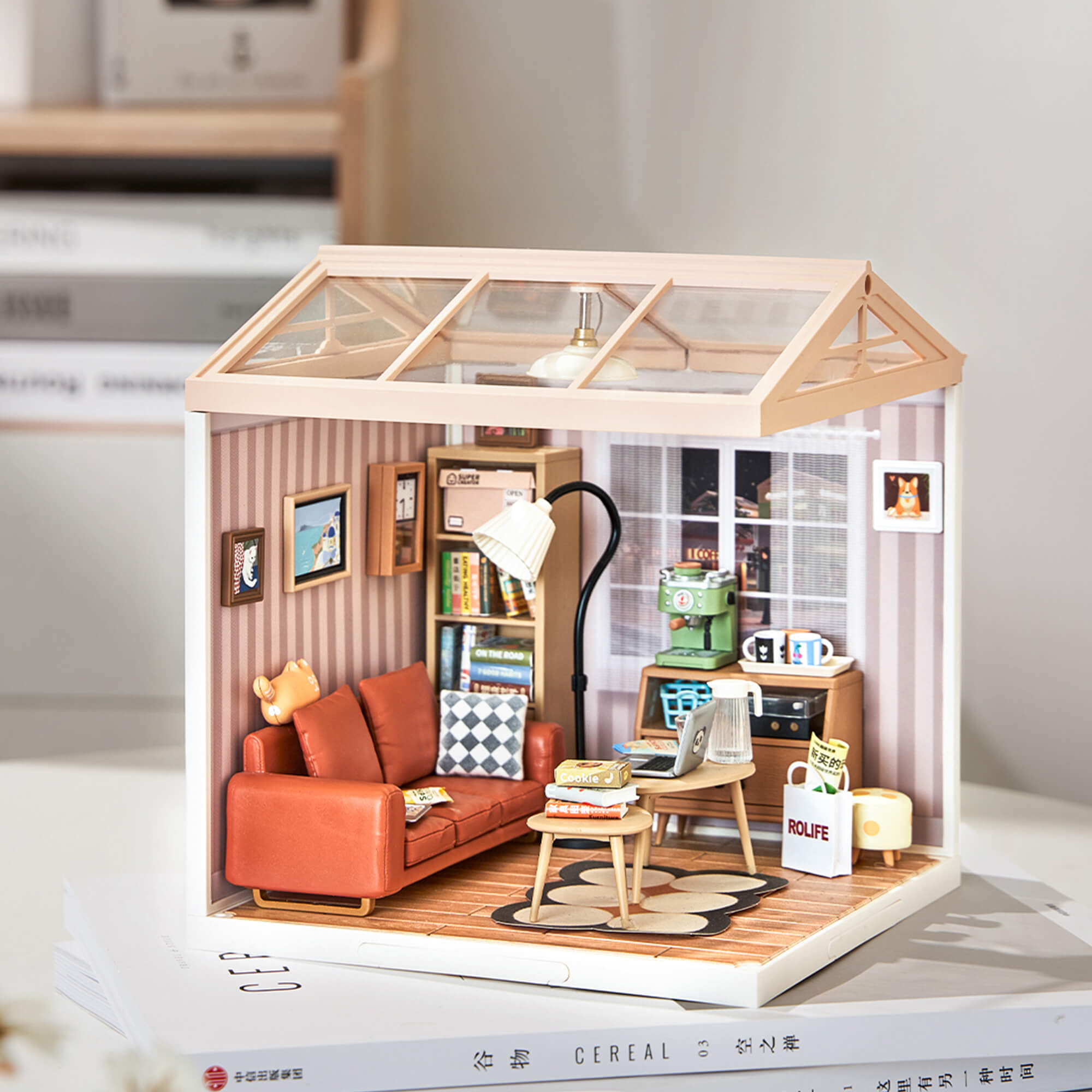
View Cozy Living Lounge DW007. Keep the lighting controls accessible when choosing the tray size and orientation.
For a longer move, follow How Do I Move a Finished Miniature House Safely?. For storage between displays, use How Should I Store Finished Rolife Kits?.
What Should You Avoid?
- Do not permanently glue the model to a shelf simply to solve light sliding; it makes cleaning, repair, and relocation harder.
- Do not place strong tape over wallpaper, printed panels, painted trim, or other visible finishes.
- Do not add loose heavy objects inside a fragile model to lower its center of gravity; they can damage the floor during movement.
- Do not wedge a book nook so tightly between books that the side panels bow or controls become inaccessible.
- Do not treat putty or gel as the only protection in a high-impact area. Reduce the risk at the shelf or room level.
Key Takeaway
The best stabilizer is the least invasive method that solves the real problem. Start with a level shelf and a hidden non-slip barrier, move to a removable base or stop if needed, and use temporary adhesive products only after checking material compatibility. For high-contact locations, relocation or an enclosed display is safer than stronger attachment.
Frequently Asked Questions
Can I use museum putty under a miniature house?
Possibly, but only if the specific product is suitable for both the miniature’s underside and the shelf. Test a hidden area first and avoid porous, freshly painted, printed, or delicate surfaces when compatibility is uncertain.
What is the easiest way to stop a miniature from sliding?
A thin piece of non-slip mat cut slightly smaller than the footprint is usually the simplest reversible starting point. Make sure the shelf is clean, dry, level, and structurally stable.
How do I stop a narrow book nook from tipping?
Place it fully on a level shelf, add a hidden non-slip layer, and use a removable base, spacer, or low side stop to increase support. Avoid squeezing it tightly between books.
Will removable adhesive damage painted furniture?
It can, depending on the adhesive, paint, surface age, heat, and contact time. Follow the adhesive manufacturer’s instructions, test a hidden spot, and choose a physical mat or tray when in doubt.
Should I glue a finished miniature into a display case?
Permanent glue is usually unnecessary if the case is level and the miniature fits securely. A fitted base, non-slip insert, or small tested removable contact points preserve the option to remove the model for cleaning or repair.
Create a Safer Display
See How to Store and Display Miniature Houses for placement ideas, or browse Rolife display boxes when you want an added barrier against dust and accidental contact.
Related Rolife Building and Display Help
If the project is still in progress, use How Should I Store an Unfinished Rolife Kit Between Building Sessions?. For shaping small decorative wire parts, continue with How to Bend Craft Wire for Miniature Details Without Kinks or Tool Marks.
If a supplied component is missing or unusable, follow What Should I Do If Parts Are Missing or Damaged? rather than adding an improvised structural part. Together with the finished-storage and safe-moving guides above, these articles form a practical building and display help path.