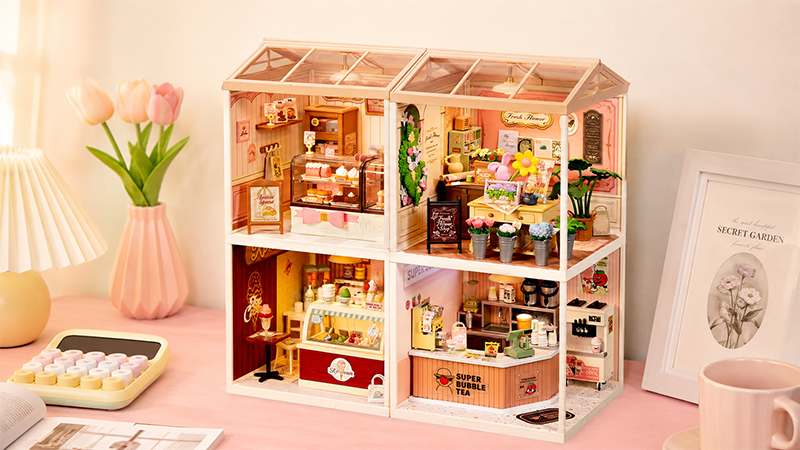
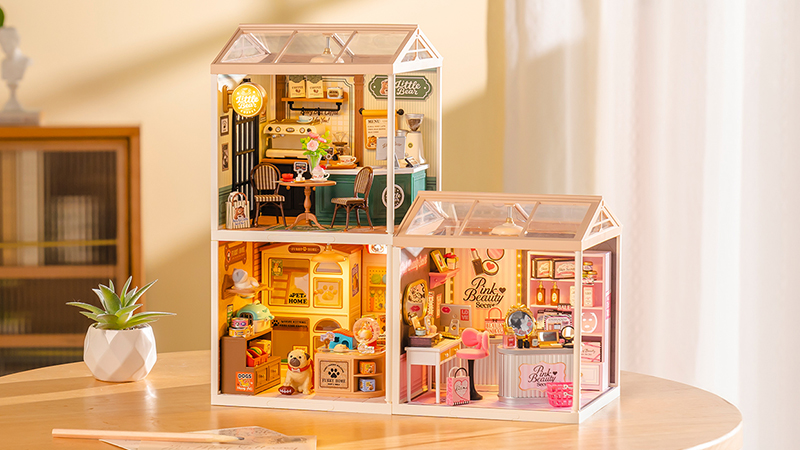

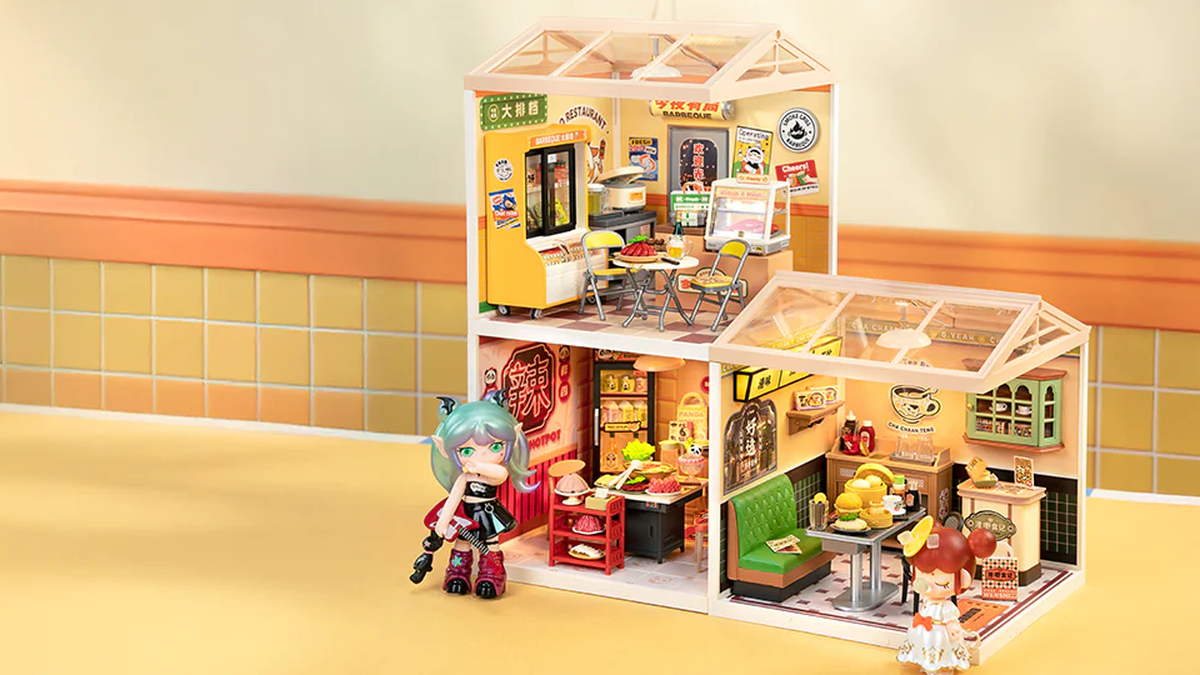
Choose your first Food Street shop by the story you want to build: a social hot pot dinner, a nostalgic Hong Kong café, or the energy of a late-night food stall. Add a second shop when it creates a useful contrast, and choose all three only when the full street suits your display space.
The three Rolife Food Street kits belong to the modular Super Creator format, but they do not create the same atmosphere. One feels like dinner with friends, one like a familiar neighborhood café, and one like a spontaneous late-night stop. The best first kit is the scene that matches the story, colors, and display location you already have in mind.
This guide compares the three shops as buying choices. For detailed street layout, shop order, lighting, and expansion ideas, use the separate guide to building a miniature Food Street display.
Food Street Kits Compared at a Glance
| Kit | Best for | Visual mood | Story strength | Good first choice if... |
|---|---|---|---|---|
| Panda Hot Pot DW020 | Social dining and food-sharing scenes | Warm, bold, playful | A group gathers around one central meal | You want an instantly readable restaurant scene |
| Hong Kong Bites Cafe DW021 | Retro city and nostalgic café displays | Cozy, cinematic, familiar | A quiet stop for milk tea, buns, and conversation | You prefer atmosphere and interior detail |
| Night Out Food Stall DW022 | Night-market and street-food storytelling | Energetic, casual, after-dark | A quick meal becomes a small city adventure | You want outdoor-stall character and movement |
All three appear in the easy-difficulty and 100-to-149-piece ranges, so theme and display style are more useful decision factors than choosing only by piece count. Always review the current product page for the exact contents and regional availability before ordering.
Which Food Street Kit Fits Your Style?
Panda Hot Pot DW020: Best for Social Dining
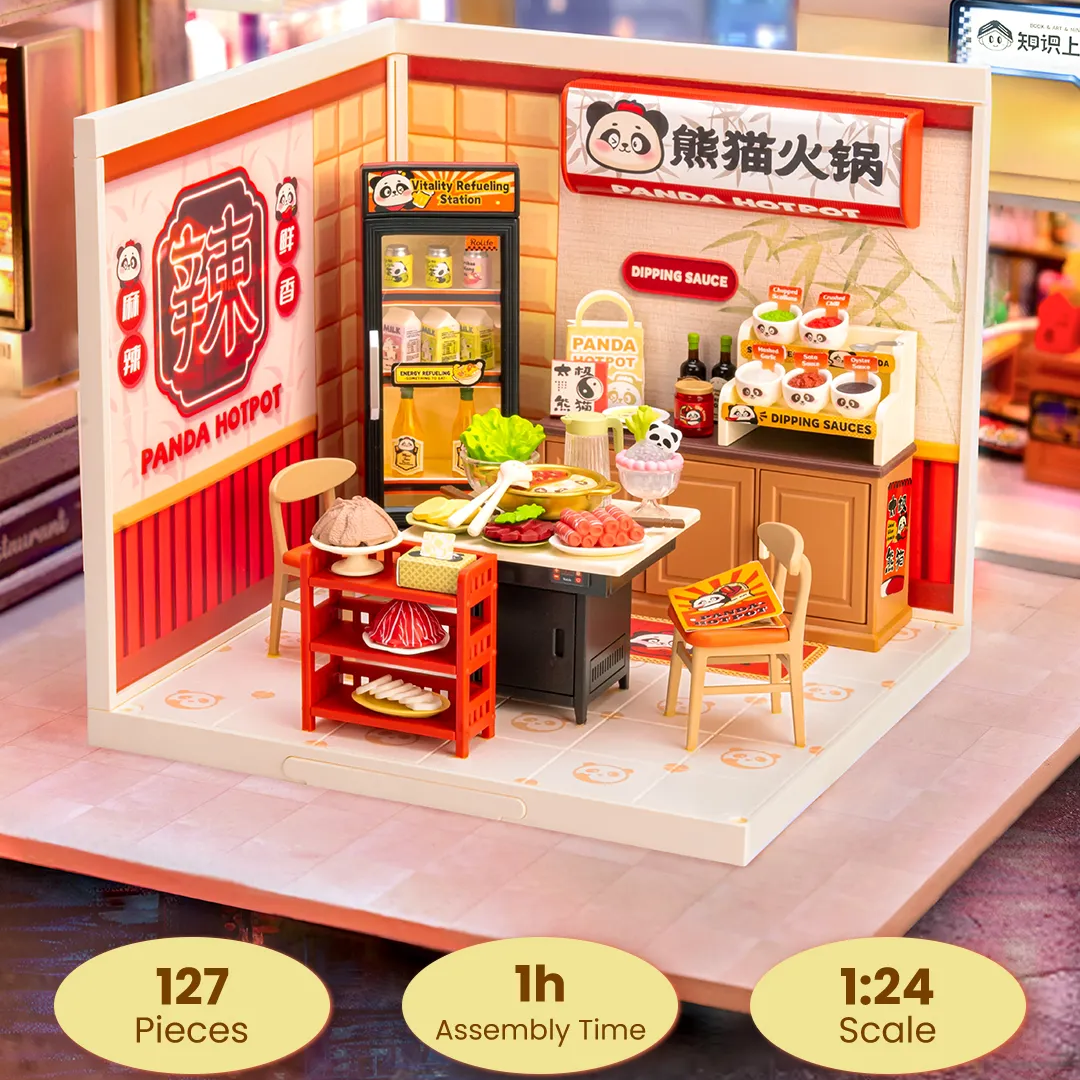
Panda Hot Pot DW020 is the clearest choice when you want a scene about people eating together. The central hot pot, bold signage, panda details, and warm red accents make the action easy to understand even from across a room.
Choose it first if your display needs one strong focal point or if you plan to add figures around a shared meal. It also works well as the visual anchor in a larger street because the restaurant reads as an indoor destination rather than a passing stop.
- Strongest motivation: Recreate the warmth of a meal shared with friends or family.
- Display advantage: Bold color and a central table give the scene immediate focus.
- Watch for: If the surrounding shelf is already very red or visually dense, use more neutral neighboring scenes.
Hong Kong Bites Cafe DW021: Best for Nostalgic City Atmosphere
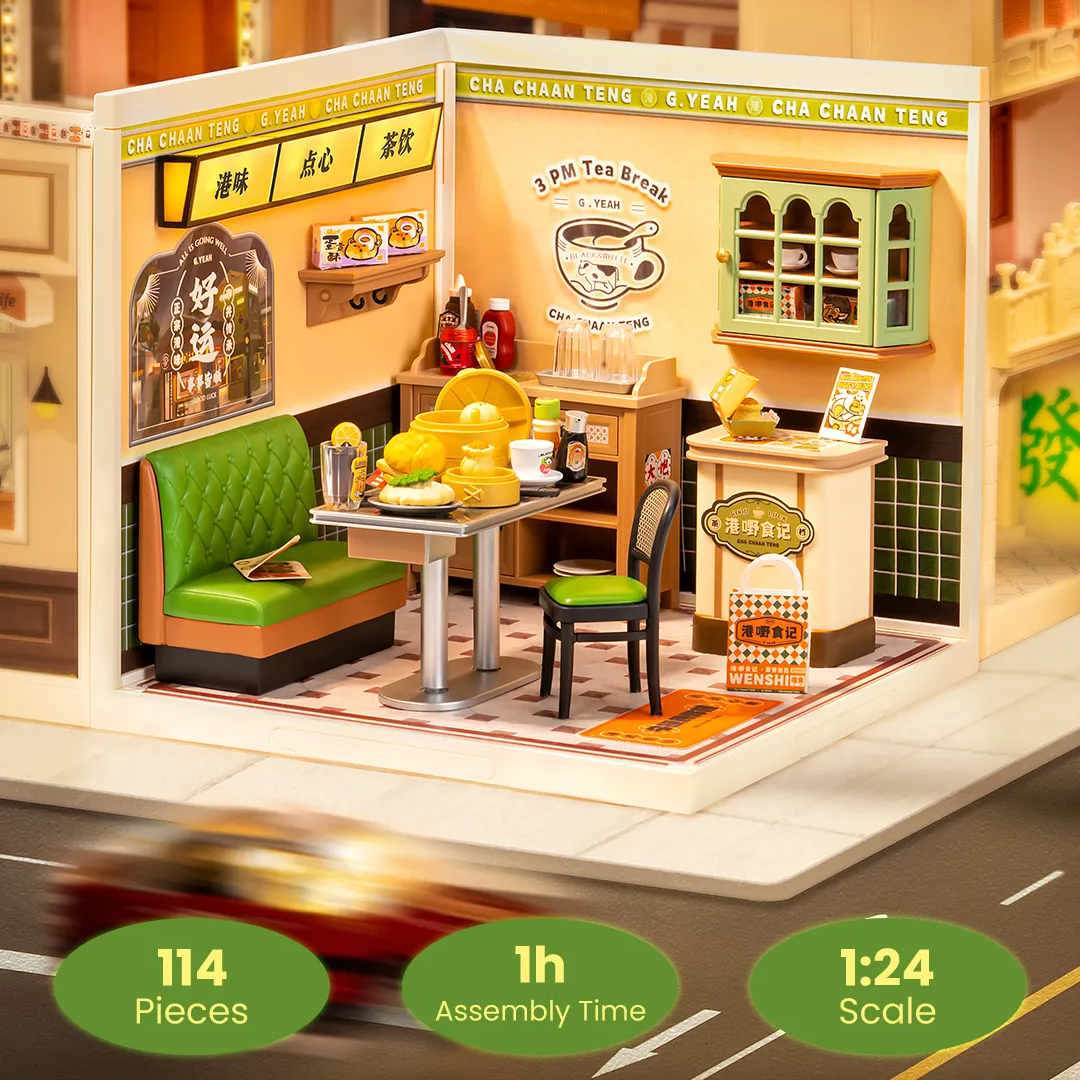
Hong Kong Bites Cafe DW021 suits collectors who care as much about place as food. Booth seating, tiled surfaces, café details, and retro visual cues turn it into a miniature memory of stopping for tea and a snack.
Choose it first if your bookshelf or desk already has a vintage, travel, or city-story theme. Its interior feels calmer than the other two shops, making it a useful bridge between a high-energy stall and a more formal restaurant.
- Strongest motivation: Hold onto the feeling of an old neighborhood café or travel memory.
- Display advantage: A balanced interior works well for eye-level viewing and quiet character scenes.
- Watch for: Give the signs and tiled details enough light to remain readable.
Night Out Food Stall DW022: Best for Night-Market Energy

Night Out Food Stall DW022 is the strongest choice for a street-level story. The tables, stools, food displays, and open-stall feeling suggest customers arriving, eating quickly, and moving on through the night.
Choose it first if you want the most energetic scene or if your figures need multiple small interaction points rather than one central table. It can also act as the street edge in a multi-shop arrangement, helping the whole display feel less like three enclosed rooms.
- Strongest motivation: Recreate the excitement of discovering food after dark.
- Display advantage: Small activity zones support varied figure placement and photography.
- Watch for: Too many loose figures and food props can make the scene feel crowded; keep one main action.
Which Shop Should You Build First?
| Your priority | Start with | Why |
|---|---|---|
| A warm, social centerpiece | Panda Hot Pot | The shared table gives the scene one strong event |
| A nostalgic shelf or travel memory | Hong Kong Bites Cafe | The café mood and retro interior reward slower viewing |
| A lively scene for figures or photos | Night Out Food Stall | Open activity zones create more ways to stage movement |
| The easiest shop to connect with quieter décor | Hong Kong Bites Cafe | Its balanced palette can transition between stronger colors |
| The boldest single display | Panda Hot Pot | Color, signage, and the central meal read clearly on their own |
| The clearest outdoor-street feeling | Night Out Food Stall | The stall format immediately expands the story beyond an interior room |
If you still cannot decide, write one sentence describing the first photograph or scene you want to create. “Friends share hot pot” points to DW020. “A quiet afternoon in an old café” points to DW021. “A late-night snack stop” points to DW022.
Best Two-Shop Food Street Pairings
Two shops work best when each has a different role. The goal is not only to double the detail; it is to create a short journey from one mood or food experience to another.
| Pairing | Best for | Story idea | Display note |
|---|---|---|---|
| Panda Hot Pot + Hong Kong Bites Cafe | A cozy dining street | Dinner first, then tea and a pastry | Use the café as the calmer neighbor to the bold restaurant |
| Panda Hot Pot + Night Out Food Stall | Maximum food and social energy | A full meal beside a busy late-night stall | Give each scene enough space so the signs do not compete |
| Hong Kong Bites Cafe + Night Out Food Stall | Retro city storytelling | Move from an indoor café to an after-dark street stop | Use lighting or figures to show the transition from inside to outside |
For shoppers starting with two, the café-and-stall pairing gives the clearest contrast between interior nostalgia and street activity. The hot-pot-and-café pairing feels more relaxed and food-focused. The hot-pot-and-stall pairing is the boldest and benefits from a wider shelf.
Should You Buy All Three Food Street Kits?
Choose the complete trio when you want a collection rather than one decorative object. All three shops make sense together because they create distinct roles: communal dining, a nostalgic café stop, and street-food energy.
The full set is a good fit when:
- You have measured a shelf, cabinet, or desk zone for the combined display.
- You enjoy rearranging modular scenes and changing the route through them.
- You want varied settings for figures, photographs, or seasonal styling.
- You prefer one coherent food theme over mixing unrelated shops.
- You are comfortable building and displaying the street in stages.
Start with one or two instead when you are unsure about available space, color balance, or how often you will restyle the display. A complete street is most satisfying when every shop has a purpose rather than simply filling an empty grid.
One-, Two-, or Three-Shop Buying Route
- One shop: Choose the scene with the strongest personal memory or display role.
- Two shops: Add a contrasting mood—indoor versus street, calm versus energetic, or dinner versus café.
- Three shops: Confirm the footprint, viewing height, lighting access, and the order that creates the clearest street journey.
Explore the Super Creator Food Street collection for the three individual shops. If you are considering a broader modular arrangement, compare options in the Super Creator Combo Pack collection.
How to Preview Your Food Street Layout Before Buying
A fast paper plan can prevent an awkward combination. Mark the available shelf width and depth, then place three paper rectangles where the shops might sit. Decide whether the arrangement will be a straight street, an L-shaped corner, or a stacked display.
- Keep the strongest hero shop near the natural viewing center.
- Place the most open street-facing scene where figures and stools have visual room.
- Check that switches, lights, doors, and removable sections remain accessible.
- Use one repeated element—sign color, figure style, street prop, or lighting mood—to make separate shops feel connected.
- Leave a little empty space at the edge so the display does not look cut off.
For full one-shop, two-shop, and three-shop layout examples, continue with How to Build a Miniature Food Street Display: Layout Ideas, Shop Order & Expansion Guide.
Which Food Street Kit Makes the Best Gift?
| Recipient | Best match | Gift message |
|---|---|---|
| Hot pot lover or social host | Panda Hot Pot | A tiny version of meals best shared together |
| Hong Kong culture or retro-design fan | Hong Kong Bites Cafe | A nostalgic café corner to build and keep |
| Night owl or street-food fan | Night Out Food Stall | A late-night food adventure in miniature |
| Super Creator collector | The missing shop in their current street | A new destination that expands an existing world |
Before gifting, check whether the recipient already owns one of the three shops and whether their display space favors a single room or a connected set.
Frequently Asked Questions
Which Food Street kit is best for beginners?
All three sit in the easy-difficulty and 100-to-149-piece ranges, so a beginner can choose mainly by theme. Panda Hot Pot has the clearest central story, Hong Kong Bites Cafe offers a calm interior, and Night Out Food Stall provides more small activity zones.
Can the Food Street kits connect with each other?
They use the modular Super Creator format and are designed to support connected or combined displays. Plan the arrangement around shelf size, access to lights and switches, and the direction you want the street to read.
Which two Food Street kits go together best?
Hong Kong Bites Cafe and Night Out Food Stall create the strongest indoor-to-street contrast. Panda Hot Pot and Hong Kong Bites Cafe make a cozy dining pair, while Panda Hot Pot and Night Out Food Stall create the highest-energy combination.
Do I need all three Food Street kits?
No. One shop can work as a complete display, and two can create a convincing short street. Buy all three when you want the full dining journey and have confirmed the display footprint.
What order should I display the three shops?
There is no single required order. A useful starting sequence is café, hot pot, then food stall: the street moves from a quieter indoor stop to a central shared meal and ends with outdoor night-market energy.
Build the Food Street That Fits You
The best Food Street purchase is not automatically the full set. Start with the shop whose story feels most personal, add a second scene that changes the mood, and expand to all three only when the complete street fits your space and the way you like to display.
Compare the current options in the Rolife Food Street collection, then use the layout guide when you are ready to turn individual shops into one connected destination.