

Follow Nita_Davis through a one-week DG104 build with custom colors, plant-making tips, and an honest setback.
Quick Answer: Rolife Community maker Nita_Davis turned Cathy’s Flower House DG104 into a personal miniature greenhouse by changing colors, rearranging details, and developing her own method for shaping the leaves. Her build unfolded over one week and included both satisfying creative choices and a few honest setbacks. The result shows why a detailed miniature can feel more meaningful when the builder treats the instructions as a starting point, not a restriction.
A finished miniature house can look effortless in a photograph. A real build story is different. It includes the early confidence, the repetitive middle, the small decisions that change the look, and the moment when the outer walls finally close around the scene.
In February 2026, Rolife Community maker Nita_Davis shared that full arc while building Cathy’s Flower House. Her posts recorded the plants she worked through, the surfaces she repainted, the detail that did not survive final assembly, and the technique she would pass to the next builder.
Who Built This Version of Cathy’s Flower House?
Nita_Davis was not approaching miniatures for the first time. In the Rolife Community discussion, she mentioned previous experience with other garden and flower-shop scenes. That experience did not make DG104 automatic. It gave her the confidence to question colors, redo plant parts, and keep adapting when the build became more demanding.
| Story fact | Detail |
|---|---|
| Rolife Community maker | Nita_Davis |
| Creation | Cathy’s Flower House DG104 |
| Shared timeline | One week from the first progress post to completion |
| Personal changes | Repainted surfaces, additional color choices, and rearranged details |
| Practical lesson | Use double-sided tape and wire together to support and shape paper leaves |
Source: Nita_Davis’s start and completion posts in Rolife Community; direct links appear below.
How Did the Build Begin?
The opening pages felt approachable. Then the flower-house work shifted into a long run of plants and small boxes. Nita described the change with humor:
“Time to saddle up and prepare for the ‘not so easy’ stuff.”
— Nita_Davis, Rolife Community
On the first day she reported completing roughly half of the plants. That detail matters because it shows a useful way to approach a botanical miniature: treat repeated components as a stage of the build rather than expecting every session to produce a nearly finished room.
Why Did She Change the Original Look?
The first visible customization happened outside the greenhouse. Nita felt the original stone effect did not work with the interior floor, so she softened the surface with watered-down brown paint and wiped it back. She also painted several other elements and reconsidered at least one dark color while the scene was still in progress.
This is a small but useful design lesson. Personalization does not have to mean rebuilding the entire kit. One surface, one accent color, or one rearranged shelf can be enough to make the finished flower house belong to its builder.
What Was the Most Demanding Part of the Build?
The plants were the longest repeated task, while the four transparent outer walls created anticipation about final assembly. Near the end, another challenge appeared: while installing the last roof and wall sections, Nita knocked off the birdhouse. After several attempts to restore it, she decided to complete the scene without that detail.
That is an honest miniature-building decision. Not every small component must survive exactly as planned for the whole scene to work. Sometimes the better choice is to protect the finished structure, accept one omission, and keep the result you are proud of.
How Did She Make the Paper Plants Easier to Shape?
Nita’s most transferable lesson came from the leaves. Instead of relying only on pushing wire through a leaf and bending it over, she used double-sided tape on the back. Pressing the wire into that taped surface created support along the leaf, almost like a central vein, so the shape could be controlled more easily.
For leaves without a wire hole, she attached tape directly to the paper leaf and then pressed it onto the wire. She liked the control enough to pull apart and rebuild a couple of plants. Her method can be summarized as follows:
- Prepare one plant at a time so the leaf sizes and wire lengths stay organized.
- Use the supplied double-sided tape as both an attachment aid and a support layer.
- Press the wire along the back of the leaf before shaping the curve.
- Redo a plant when the new shape materially improves the composition; perfection is not required for every leaf.
How Long Did the Builder Journey Take?
Nita’s public build journey ran for one week. That is a calendar timeline, not a measured total of hands-on hours. The current Cathy’s Flower House DG104 contains 389 pieces and has an estimated assembly time of 7.5 hours, but customization, repainting, breaks between sessions, and rebuilding details can all extend the personal experience.
For a new builder, the most useful plan is not to race the estimate. Divide the project into natural stages: base and furniture, plants, staging, and transparent exterior assembly. Stop at the end of a stage instead of in the middle of a delicate component. Review the DG104 assembly guide before beginning the transparent exterior.
What Did Completion Feel Like?
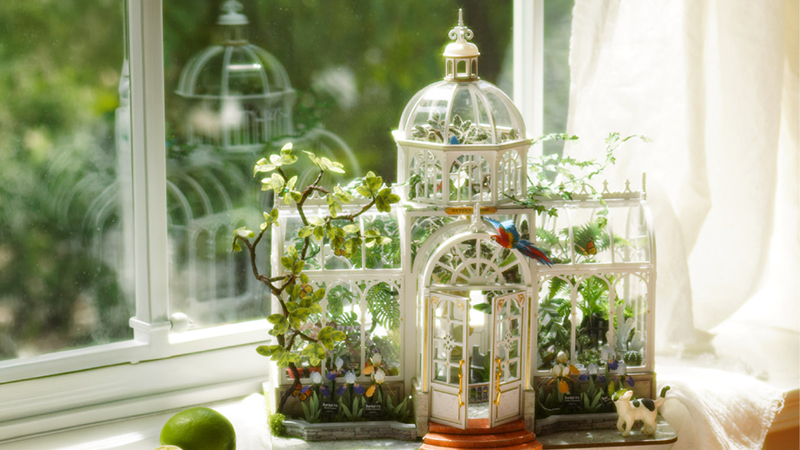
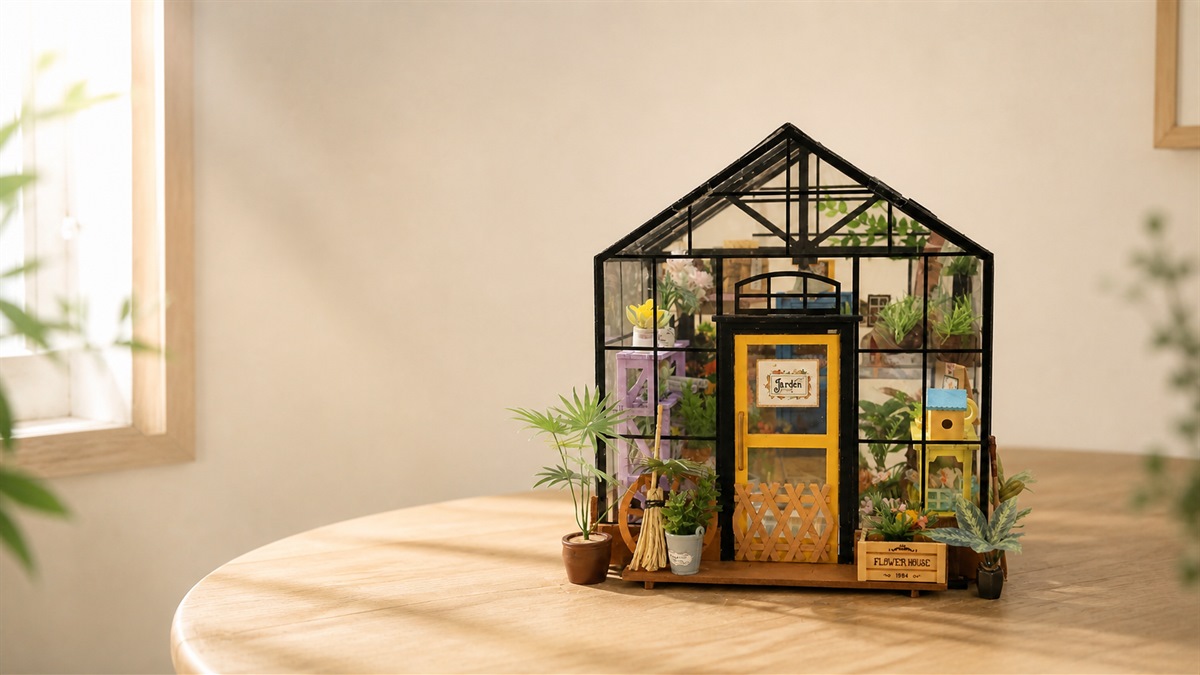
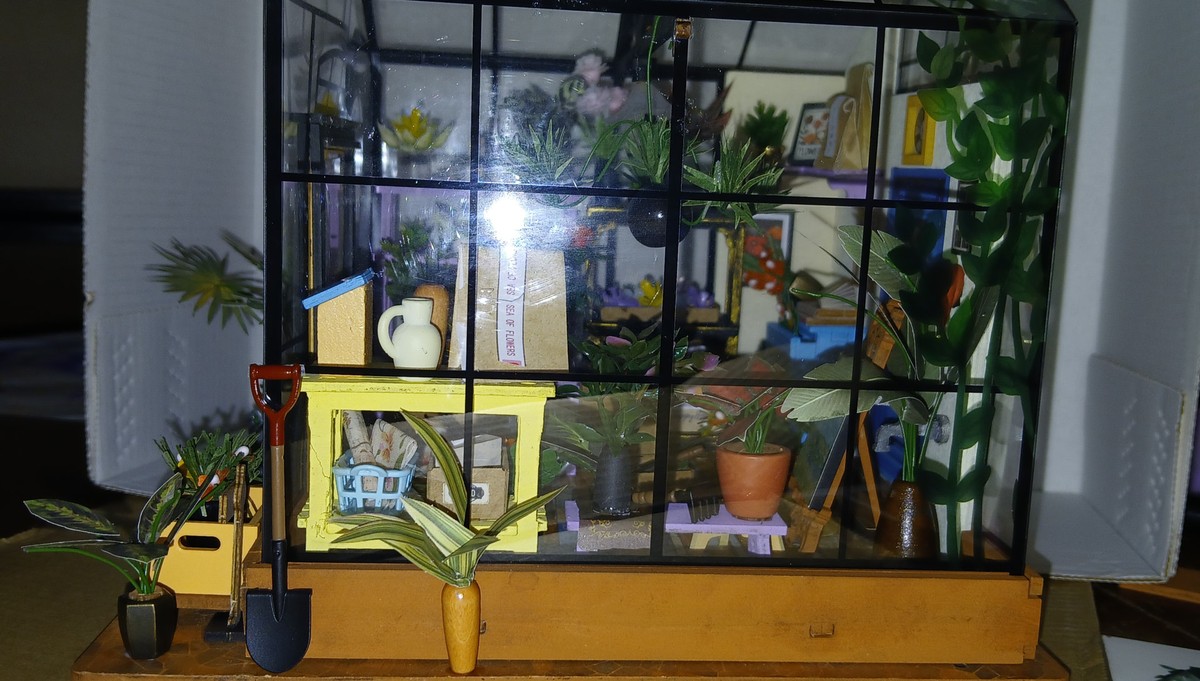
The completion post opened with relief and satisfaction after a demanding week. The photographs documented the finished transparent structure, the customized colors, and the dense botanical interior. Other Rolife Community members specifically noticed the clarity of the windows and the work in the plants.
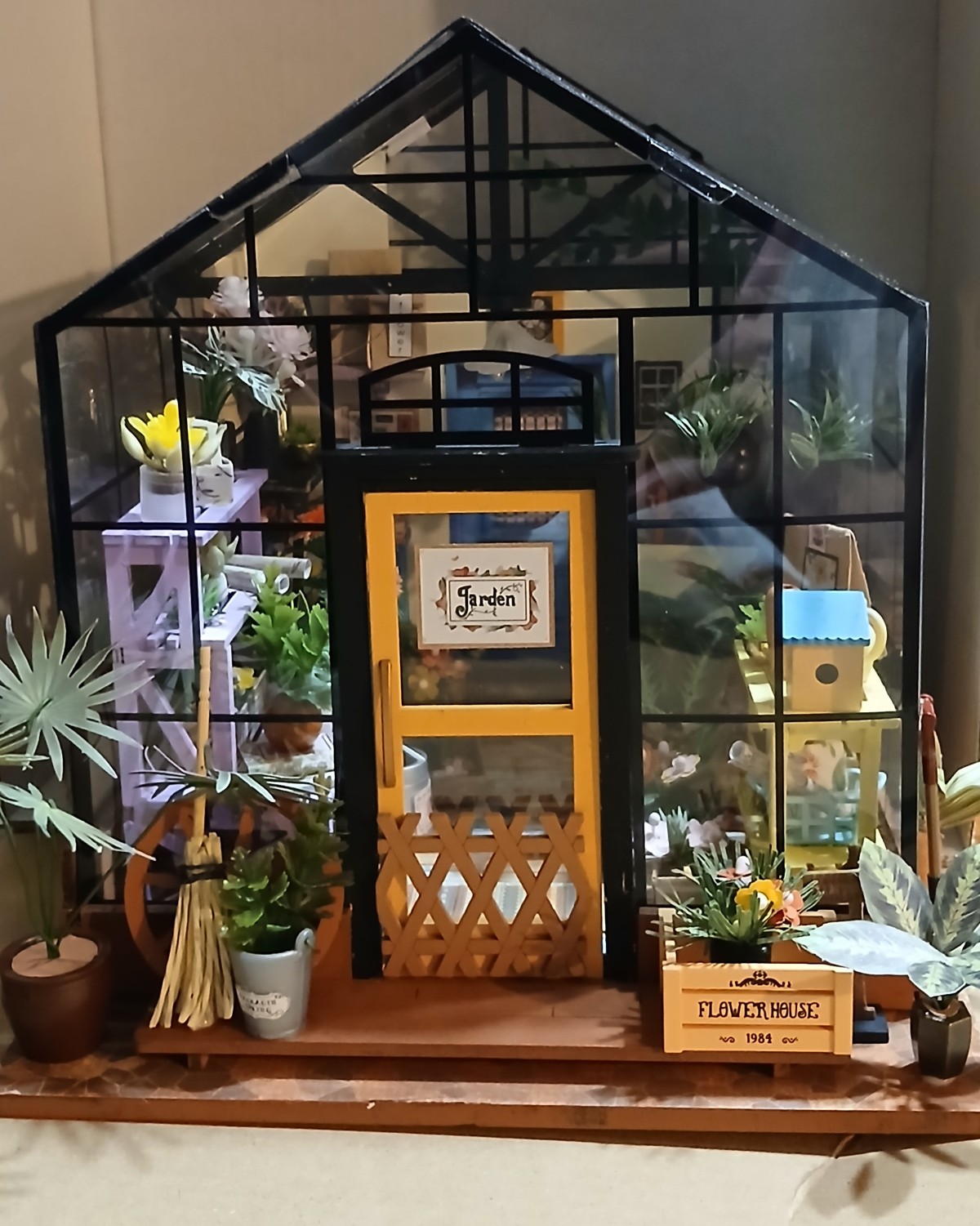
“After one week, I have finally completed Cathy’s flower house.”
— Nita_Davis, Rolife Community
The finished piece was not a flawless copy of a diagram. It was a record of choices: which colors to change, which plants to rebuild, where to use tape, how to shape the leaves, and when to let one missing birdhouse remain missing. That is what turned the kit into her own garden story.
What Can Future DG104 Builders Learn from This Story?
- Review the color relationships early. It is easier to repaint a base or shelf before the greenhouse fills with furniture and plants.
- Batch the botanical work, but keep individual plant parts separated and labeled.
- Use wire as structure, not only as an attachment point; supported leaves are easier to pose.
- Finish and secure loose interior details before installing the last transparent walls and roof sections.
- Allow the scene to differ from the instructions. Rearrangement and selective omission can still produce a coherent flower house.
Is This Builder Experience Typical?
Every miniature builder works at a different pace, and one Rolife Community story should not be treated as a universal difficulty rating. Nita’s account is valuable because it shows the decisions hidden behind the finished photographs. It demonstrates that DG104 can reward patience and customization, while also being candid about repetitive plants and delicate final assembly. For a more extensive transformation, compare Sandi’s Itty-Bitty Potting Shed customization.
Builders who prefer a faster, simpler project should compare difficulty, piece count, and assembly time before choosing a kit. Those who enjoy botanical details, staging, and changing colors are more likely to appreciate the flower house’s many small creative decisions.
Explore the wider garden world: Visit Slow Living & Indoor Garden Ideas to connect this personal build with botanical decor, mindful making, and the dream of creating a sanctuary at home.
Key Takeaway
Cathy’s Flower House became a personal sanctuary because its builder did more than assemble it. She edited colors, rearranged the scene, solved a plant-making problem, accepted an imperfect moment, and completed a miniature that visibly carried her choices.
Frequently Asked Questions
How many pieces are in the current Cathy’s Flower House DG104?
The current Rolife Cathy’s Flower House DG104 contains 389 pieces.
How long does Cathy’s Flower House DG104 take to build?
The estimated assembly time is 7.5 hours. A customized build may take longer, and a calendar timeline can include breaks between sessions.
Can builders customize Cathy’s Flower House?
Yes. Builders can change colors, rearrange movable details, adjust plant shapes, and simplify selected elements. Test paint and placement before closing the transparent exterior.
What part did this Rolife Community maker find challenging?
Her posts focused on the large number of plants, the anticipated difficulty of the transparent walls, and a birdhouse that came loose during final roof and wall assembly.
What plant-making tip did she share?
She used double-sided tape behind the paper leaves and pressed the wire against it. The wire supported the leaf like a vein and made the shape easier to control.
Does DG104 suit a first-time miniature builder?
A patient and organized beginner may enjoy it, but the 389-piece build is detailed and carries a four-out-of-five difficulty rating. A simpler kit may be more comfortable for someone who dislikes repetitive botanical work or delicate small parts.
Create Your Own Tiny Garden Story
If you enjoy plant-filled scenes and the freedom to make small design choices, explore Cathy’s Flower House DG104. For display inspiration, see how to create a relaxing indoor garden space or compare other flower shop and garden house kits.
Rolife Community Sources
Nita_Davis, “Cathy’s Flower House start,” Rolife Community, February 7, 2026. View the progress post
Nita_Davis, “Cathy’s Flower House completion,” Rolife Community, February 12, 2026. View the completion post