

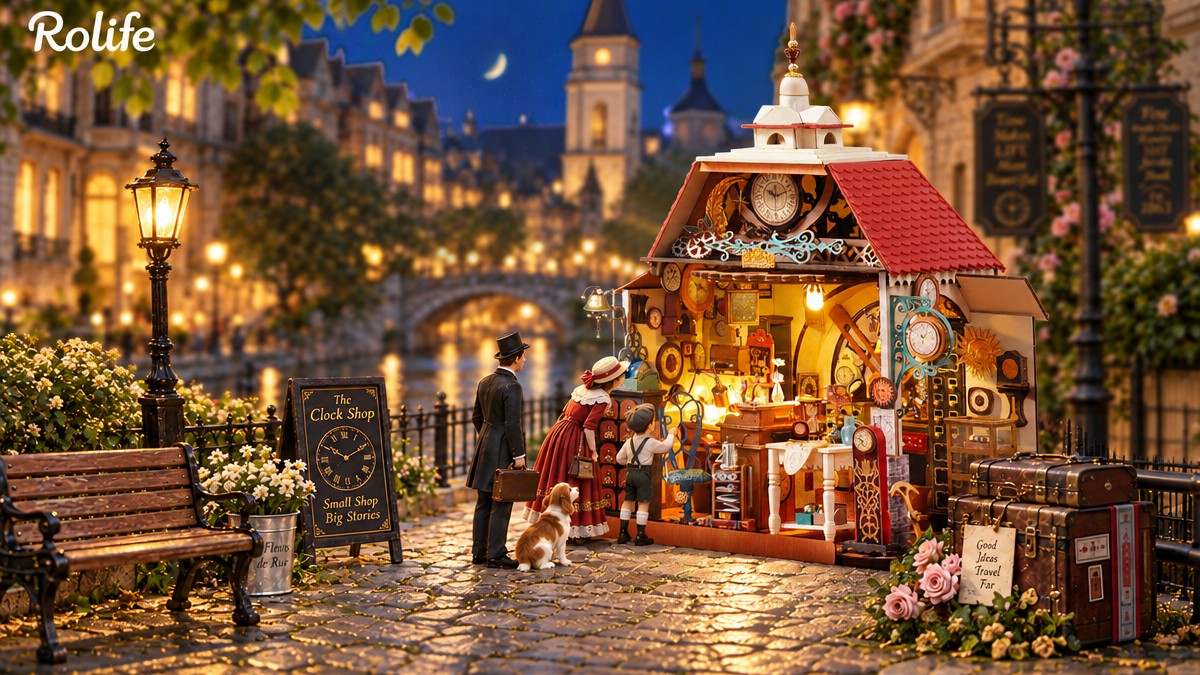
Some places seem to move at a different speed.
A quiet workshop.
Warm light falling across old wood.
Tiny gears resting beside a pair of tweezers.
A magnifying lens left on the workbench.
And all around the room, clocks ticking at their own steady rhythm.
Meet Rolife Clockwise Clocks DH104, a Master-Level DIY Art House inspired by the atmosphere of an old European clock shop and the meticulous world of traditional watchmaking.
With 739 pieces, approximately 27 hours of assembly, and a ★★★★★★ difficulty level, Clockwise Clocks is designed for experienced makers who want more than a decorative miniature.
It is a long-form craftsmanship project.
A study in mechanical beauty.
And a tribute to the people who spend their lives repairing something none of us can hold:
time.
Quick Answer
Rolife Clockwise Clocks DH104 is a 739-piece Master-Level DIY miniature clock shop inspired by European horology, antique clock stores, and traditional repair workshops.
The model features:
- Approx. 27-hour assembly
- ★★★★★★ Master-Level difficulty
- More than 40 clock-related elements
- Vintage European shop architecture
- Watchmaker’s workbench and repair tools
- Brass-like gears and mechanical details
- Antique clocks and pocket-watch-inspired displays
- Multi-material craftsmanship
- Foil embossing
- Hand-shaped wirework
- Miniature hardware assembly
- Two warm lighting areas
- Giant clock-face backdrop
- Attic clock structure
- Decorative ironwork and weathered metal styling
Clockwise Clocks is designed for experienced DIY builders, mechanical-aesthetic enthusiasts, vintage décor lovers, and anyone drawn to the quiet discipline of traditional craftsmanship.
Step Into an Old European Clock Shop
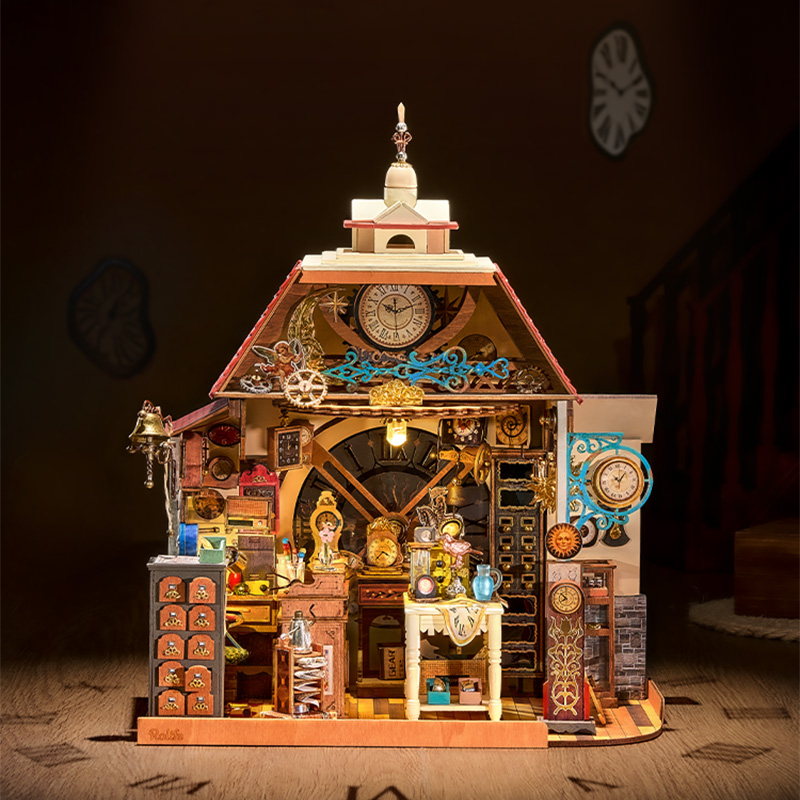
At the corner of a quiet street hangs a blue-green metal sign.
Curving ironwork wraps around a round clock face.
The sign alone is enough to make you stop.
Step inside, and the city seems to disappear.
There is no rush here.
Only the steady rhythm of ticking clocks.
The smell of wood.
Old paper.
Metal.
A little machine oil.
Warm light spreads across shelves filled with timepieces from different eras.
A large clock face glows on the back wall.
Pocket watches rest behind glass.
On the repair table, tiny gears, tweezers, drawings, and tools wait patiently.
This is not just a shop.
It is a place where time is examined piece by piece.
The Clockmaker Does More Than Repair Clocks
The emotional core of Clockwise Clocks comes from one idea:
A clockmaker is not simply fixing a mechanism.
They are restoring time.
A worn gear begins to move again.
A stopped hand returns to motion.
An old clock that has been silent for years starts ticking once more.
Each restored object carries something from the past.
A room.
A family.
A memory.
A particular hour someone once waited for.
In that sense, every repair becomes a form of preservation.
Clockwise Clocks turns that idea into a miniature world.
A Master-Level DIY Project for Experienced Makers
Clockwise Clocks is not designed as a quick build.
It includes:
739 pieces
Approx. 27 hours of assembly
★★★★★★ Master-Level difficulty
The challenge is part of the product.
This is for builders who enjoy:
- Fine detail work
- Multi-stage assembly
- Complex miniature scenes
- Material experimentation
- Long-form crafting
- Precision and patience
The satisfaction comes from building slowly.
From seeing a complicated scene emerge piece by piece.
And from knowing that the finished result reflects the time you invested in it.
A New Level of Hands-On Craftsmanship
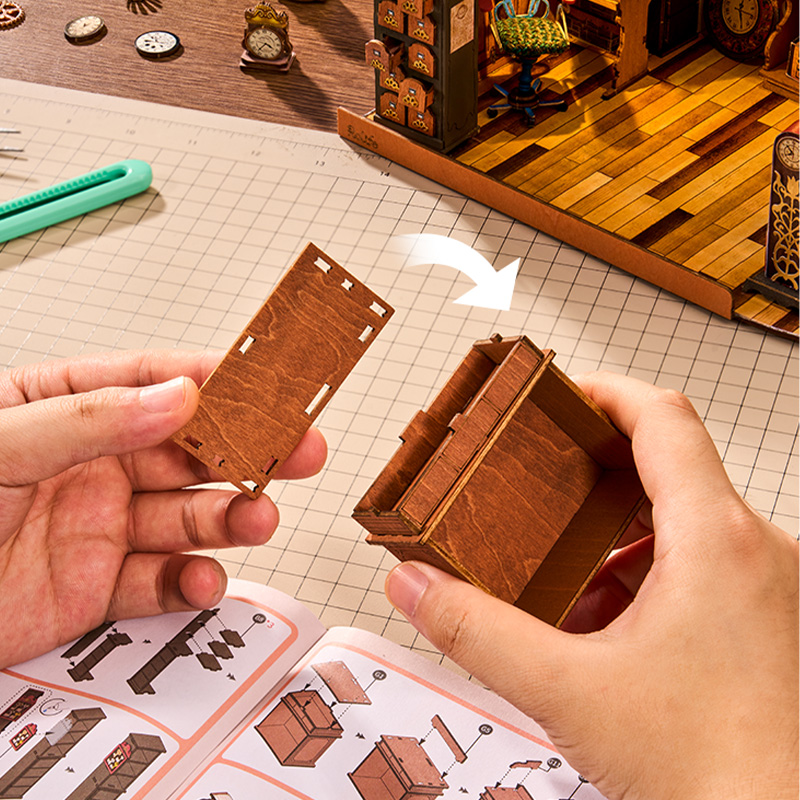
One of the strongest differences between Clockwise Clocks and simpler miniature kits is the variety of manual techniques involved.
The build introduces more advanced DIY forms such as:
- Foil embossing
- Hand-shaped wire
- Small metal hardware
- Multi-material component construction
- Glue-based detail assembly
- Carved and layered miniature parts
Some individual objects require several different materials and techniques before they are complete.
That means the project is not simply about assembling a house.
It is about making the objects inside it.
Foil Embossing Adds Another Layer of Craft
Clockwise Clocks introduces foil embossing as part of the DIY process.
This allows certain decorative surfaces to gain more texture and dimensionality.
Instead of relying entirely on printed or molded details, the builder participates more directly in creating the visual effect.
That matters because the whole theme of the product is craftsmanship.
The making process supports the story.
You are building a clockmaker’s workshop while working more like a miniature craftsperson yourself.
Shape the Details by Hand
The project also requires hand-forming wire into specific shapes.
That may sound like a small task.
But it changes the character of the build.
The parts are not simply removed and clicked into place.
Some details need to be shaped.
Adjusted.
Positioned.
Then combined with miniature hardware.
That kind of work demands more patience and control.
For experienced DIY builders, this is exactly where the challenge becomes rewarding.
More Than 40 Clock Elements Fill the Shop
Clockwise Clocks contains 40+ clock-related elements across the scene.
They include both conventional and unusual forms inspired by different periods and styles.
The variety helps the model feel like a real specialist shop rather than a generic vintage room.
You may find:
- Wall clocks
- Desk clocks
- Pocket-watch-inspired pieces
- Longcase clocks
- Mechanical clock elements
- Hand-crank timepieces
- Public-clock-inspired designs
- Decorative clock faces
- Gear-based mechanisms
- Clockmaking tools
Together, they create a miniature visual history of timekeeping.
The Watchmaker’s Workbench: Where Time Is Repaired
The workbench is one of the most important areas in the model.
This is where the story becomes personal.
The desk includes:
- Warm task lighting
- Repair tools
- Small gears
- Precision instruments
- Components waiting for assembly
- Drawings and technical materials
The arrangement recreates the focused environment of a clock repairer.
Nothing is placed randomly.
Every object suggests concentration.
Precision.
Routine.
The quiet discipline of someone who has repeated the same careful movements for years.
A Wall Full of Time
Behind the workstation is a dense collection of clock faces.
Different shapes.
Different styles.
Different periods.
The wall gives the impression that the shop has been operating for a long time.
Some clocks feel decorative.
Others feel technical.
Together, they create visual weight and historical depth.
It is easy to imagine each one arriving from a different home with a different story.
A Classic Lever Clock Brings Mechanical History Into the Scene
Among the more distinctive pieces is a side-hammer lever-style clock.
Its form references an earlier stage in the development of mechanical timekeeping.
In the miniature, it does more than add visual complexity.
It helps connect the scene to the broader idea of mechanical civilization:
the moment when time became something humans could measure through gears, motion, and repeated mechanical rules.
That sense of history is central to Clockwise Clocks.
A Chair Made for Long Hours of Careful Work
Even the chair supports the story.
Its design combines:
- European-inspired decorative back
- Textured seat
- Vintage rolling base
It looks like a place where someone has spent many hours sitting still, leaning over tiny parts, adjusting mechanisms one piece at a time.
The room is not only filled with objects.
It suggests a way of life.
The Central Display: Time as Science, Art, and Memory
The center of the shop brings together several symbolic objects.
Mechanical Cuckoo Figure
The metal mechanical figure reflects an old fascination with making machines imitate life.
It connects timekeeping with invention and mechanical imagination.
Hourglass
Before gears and springs, time could be measured more simply.
The hourglass introduces another visual language of time.
Less mechanical.
More elemental.
Surreal Time Reference
The model also includes an artistic reference to the idea that time is not always experienced in the same way it is measured.
Mechanical clocks may divide time precisely.
Human memory does not.
A minute can feel long.
A year can disappear quickly.
That contrast adds a more philosophical layer to the product.
The Giant Clock Face Defines the Entire Workshop
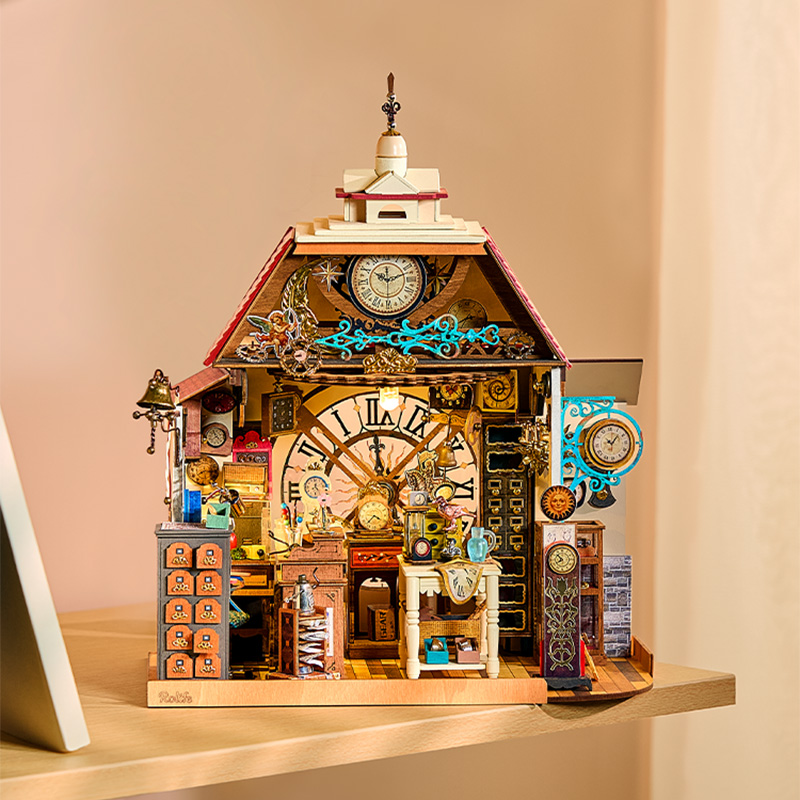
At the back of the room stands a giant clock-face wall.
This is the visual anchor of Clockwise Clocks.
It turns the entire interior into a space shaped by time.
The scale of the clock face makes it feel almost architectural.
Less like an object.
More like part of the building itself.
That helps reinforce the central concept:
In this shop, time is everywhere.
Antique Clocks From Different Eras
The rear display area includes several different clock forms.
Among them:
- Table clocks
- Longcase clocks
- Nordic-inspired tall clocks
- Hand-crank striking clocks
- Winding keys
Each type suggests a different period in the evolution of domestic and public timekeeping.
The result is not a strict museum reconstruction.
Instead, it creates the feeling of a shop that has collected timepieces across generations.
A Winding Key Turns Time Into Ritual
The winding key is a small detail with strong symbolic value.
Before automatic mechanisms and electronic clocks, keeping time required participation.
Someone had to wind the mechanism.
Again.
And again.
That repeated action became part of everyday life.
In Clockwise Clocks, the winding key represents the ritual behind mechanical time.
Time does not simply run.
Someone has to keep it moving.
The Exterior Feels Like a Real Old Clock Shop
The exterior continues the same visual language.
Iron Clock Sign
The European-style hanging clock sign immediately identifies the building as a specialist clock shop.
Its blue-green aged-metal appearance helps create the feeling of weathered history.
Glass Display Cabinet
A vintage glass display case presents smaller timepieces like valuable objects.
Large Clock Structure
A larger clock-related mechanism adds visual drama near the storefront.
It helps make the building recognizable even before the viewer sees the interior.
The Rooftop Becomes a Mechanical Landmark
The attic and roof area continue the theme of time.
You will find:
- Public-clock-inspired structures
- Decorative gears
- Metal details
- Ornamental hands
- A gilded moon-face motif
- Weathered blue-green surfaces
These elements give the roof a slightly more mysterious, almost mechanical-fantasy character.
The result sits somewhere between:
European antique shop.
Clock tower.
Mechanical workshop.
And miniature monument to time.
Brass, Wood, Glass, Fabric, Wire, and More
Another major strength of DH104 is its material variety.
The product goes beyond the usual combination of wood and paper.
Materials and effects include:
- Wood
- Paper
- Plastic
- Metal
- Wire
- Miniature hardware
- Beads
- Fabric seating
- Soft silicone
- Foil
This variety makes the finished scene feel richer and more tactile.
It also makes the build more interesting for experienced users.
Different materials require different handling.
That variety helps the 27-hour build feel more like a sequence of craft tasks rather than one repeated assembly process.
Two Warm Lights Create a Quiet Workshop Atmosphere
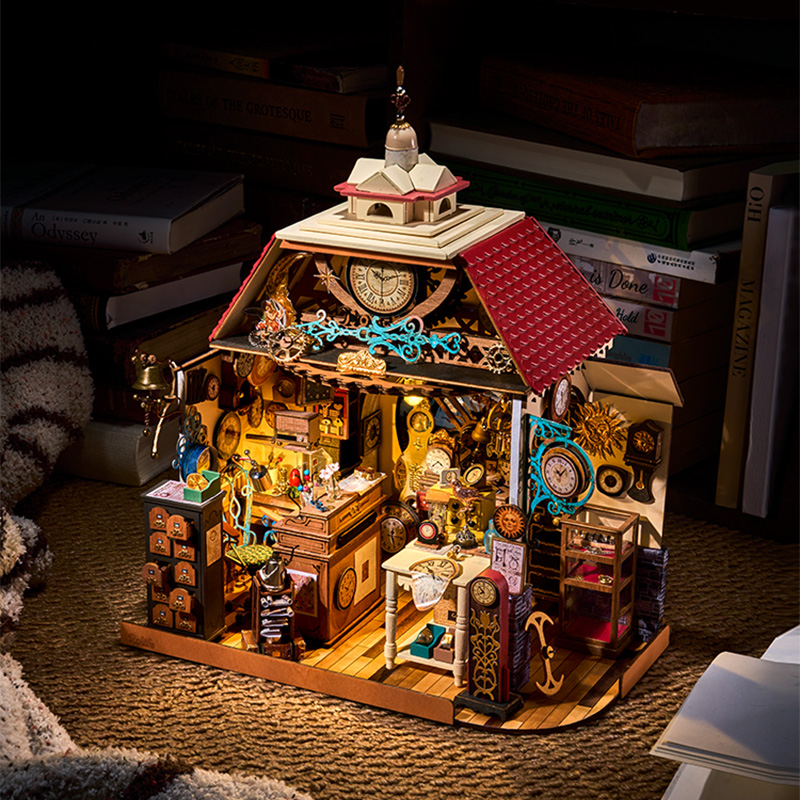
Clockwise Clocks includes two warm lighting areas.
The light is intentionally soft.
It does not turn the scene into a bright showroom.
Instead, it reinforces the feeling of late-night concentration.
A warm work lamp over the repair table.
Ambient light across the clocks.
The lighting creates the sense that the shop is still open long after the street outside has gone quiet.
Why Clock Shops Feel So Calming
There is something unusual about a room full of clocks.
They are all measuring time.
But the atmosphere often feels slower.
That contradiction is part of the appeal.
Ticking creates rhythm.
Ordered shelves create structure.
Mechanical systems follow rules.
Every tool has a purpose.
For people who find comfort in order and repetition, this environment can feel surprisingly calming.
Clockwise Clocks captures that feeling visually.
The room is complex.
But never chaotic.
A DIY Project for People Who Want to Slow Down
A 27-hour build is not designed for speed.
That is the point.
Clockwise Clocks asks you to spend time.
To concentrate.
To repeat small actions.
To solve tiny construction problems.
To work carefully.
In a daily life shaped by fast information and constant interruption, that kind of project offers a completely different rhythm.
There is no shortcut.
The value comes from staying with it.
A Strong Fit for Mechanical-Aesthetic Fans
Clockwise Clocks will especially appeal to people who enjoy:
- Gears
- Brass details
- Antique machinery
- Precision instruments
- Mechanical structures
- Workshops
- Industrial craft
- Vintage objects
Even users who are not traditional miniature-house fans may connect with the product because of its stronger mechanical identity.
It feels more like a workshop model than a decorative dollhouse.
A Mature Alternative to Sweet Miniature Scenes
Many miniature houses focus on:
- Cafés
- Bedrooms
- Florists
- Cute stores
- Romantic homes
Clockwise Clocks takes a more mature direction.
Its palette is quieter.
Its story is more reflective.
Its details are less about cuteness and more about craftsmanship.
That makes it especially suitable for users who prefer:
- Vintage interiors
- Mechanical culture
- Antique aesthetics
- Historical atmosphere
- More restrained décor
It broadens what a DIY miniature house can be.
A Display Piece With Cultural Depth
The finished model is not only visually detailed.
It carries a strong theme.
Timekeeping.
Craftsmanship.
Mechanical order.
Repair.
Memory.
This gives the product more cultural depth than a purely decorative scene.
For collectors, that can make the piece feel more meaningful.
It is not only “a beautiful old shop.”
It is a miniature world built around one of humanity’s oldest obsessions:
how to understand time.
Who Is Clockwise Clocks For?
Vintage European Culture Lovers
For people drawn to old shops, antique interiors, aged metal, dark wood, and traditional craftsmanship.
Horology Enthusiasts
For people interested in clocks, watches, mechanical timekeeping, and the visual language of repair workshops.
Experienced DIY Builders
The 739 pieces, 27-hour assembly, material variety, foil embossing, wire shaping, and miniature hardware make it a serious project.
Mechanical-Aesthetic Fans
Gears, clock faces, workshop tools, and metal details give the model a stronger technical personality.
Slow-Living Makers
For users who enjoy long, quiet projects that reward patience and concentration.
Collectors
The finished model has strong shelf and display value because of its density, architectural presence, and mature visual style.
Product Details

| Feature | Details |
|---|---|
| Product Name | Clockwise Clocks |
| Model | DH104 |
| Product Type | DIY Art House / Miniature Clock Shop |
| Pieces | 739 pcs |
| Materials | Wood, Paper, Plastic, Metal |
| Assembly Time | Approx. 27 hours |
| Difficulty | ★★★★★★ Master Level |
| Finished Size | 242 × 180 × 290 mm |
| Package Size – International | 310 × 230 × 65 mm |
| Package Size – Domestic | 315 × 237 × 65 mm |
| Lighting | 2 warm lighting areas |
| Clock Elements | 40+ |
| Advanced Craft Techniques | Foil embossing, wire shaping, miniature hardware assembly |
What Makes Clockwise Clocks Special?
Clockwise Clocks combines:
✔ 739-piece Master-Level build
✔ Approx. 27-hour assembly
✔ ★★★★★★ difficulty
✔ European vintage clock-shop theme
✔ 40+ clock-related details
✔ Watchmaker’s repair bench
✔ Precision tools and gear components
✔ Giant clock-face backdrop
✔ Antique-style clocks from multiple eras
✔ Mechanical and cultural storytelling
✔ Foil embossing
✔ Hand-shaped wirework
✔ Miniature metal hardware
✔ Multi-material crafting
✔ Two warm lighting areas
✔ Mature vintage display aesthetic
✔ Strong collector value
But the most distinctive element is the relationship between theme and process.
You are building a workshop about craftsmanship.
And the only way to complete it is through craftsmanship of your own.
FAQ
What is Rolife Clockwise Clocks DH104?
Rolife Clockwise Clocks DH104 is a Master-Level DIY miniature art house designed as a vintage European clock shop and watchmaker’s workshop, featuring more than 40 clock-related elements, repair tools, gears, antique clock displays, advanced craft techniques, and warm lighting.
How long does Clockwise Clocks take to build?
The estimated assembly time is approximately 27 hours.
How difficult is Clockwise Clocks?
It has a ★★★★★★ Master-Level difficulty rating, making it one of the more challenging Rolife DIY Art House projects.
How many pieces are included?
Clockwise Clocks includes 739 pieces.
Is Clockwise Clocks suitable for beginners?
Because of its 27-hour build time, complex detail work, wire shaping, foil embossing, miniature hardware, and multi-material assembly, it is better suited to experienced DIY builders.
Does Clockwise Clocks include advanced DIY techniques?
Yes. The build includes techniques such as foil embossing, hand-shaped wirework, miniature hardware assembly, carving-style detail work, and multi-material component construction.
How many clock details are in the model?
The design includes more than 40 clock-related elements, ranging from familiar clock forms to more unusual mechanical and historical styles.
Does Clockwise Clocks have lights?
Yes. It includes two warm lighting areas that help recreate the quiet atmosphere of a traditional repair workshop.
What kind of décor style does Clockwise Clocks fit?
It works particularly well with vintage, antique-inspired, mechanical, steampunk-adjacent, industrial, dark academia, or classic European-style décor.
Is Clockwise Clocks only for clock collectors?
No. While horology enthusiasts may appreciate the theme most deeply, the product is also designed for experienced miniature builders, mechanical-aesthetic fans, vintage décor lovers, and people who enjoy long-form craft projects.
Build a Workshop Where Time Can Begin Again
A stopped clock looks silent.
But inside it, everything is still there.
The gears.
The spring.
The hands.
The mechanism.
Waiting.
A careful craftsperson opens the case.
Examines the problem.
Adjusts a tiny part.
And eventually, the hand moves again.
Tick.
Tick.
Tick.
With Rolife Clockwise Clocks DH104, you are not simply building a miniature clock shop.
You are building a world shaped by patience.
Precision.
Memory.
And the belief that even something stopped by time can begin moving again.
Piece by piece.
Hour by hour.
Until the workshop is complete.
For another long-form project, explore advanced Rolife kits, or discover the garden setting of Leafree Café and the literary world of Pagestory Books.