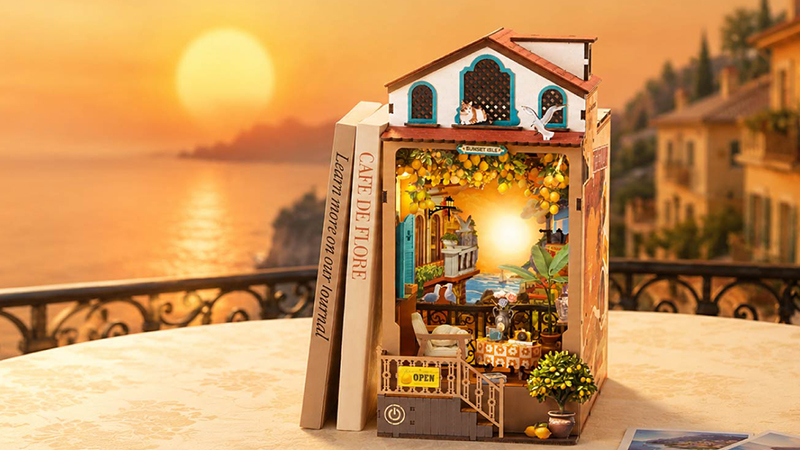
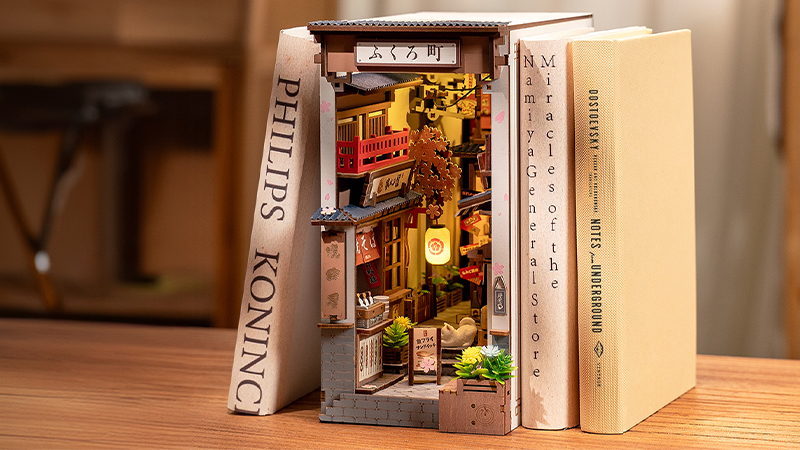
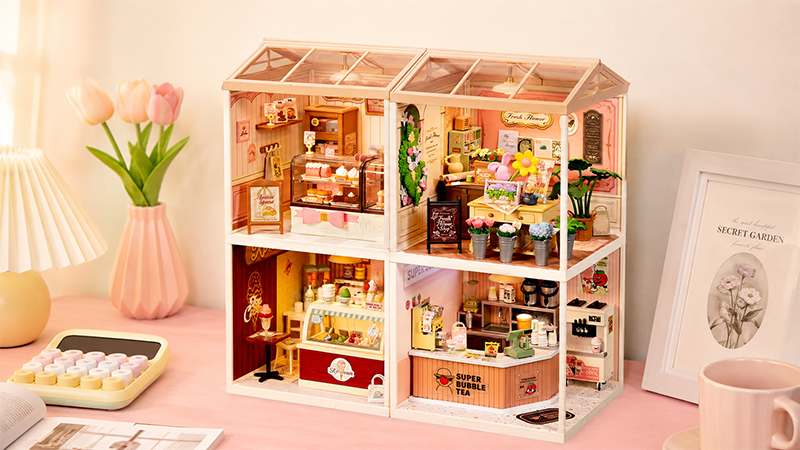
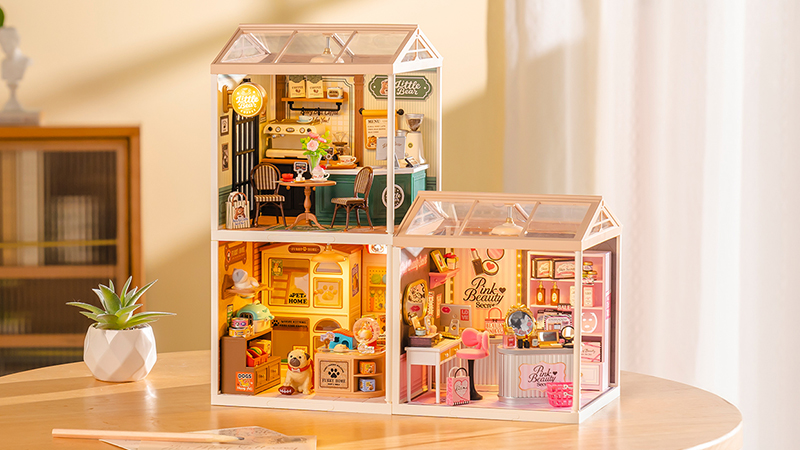

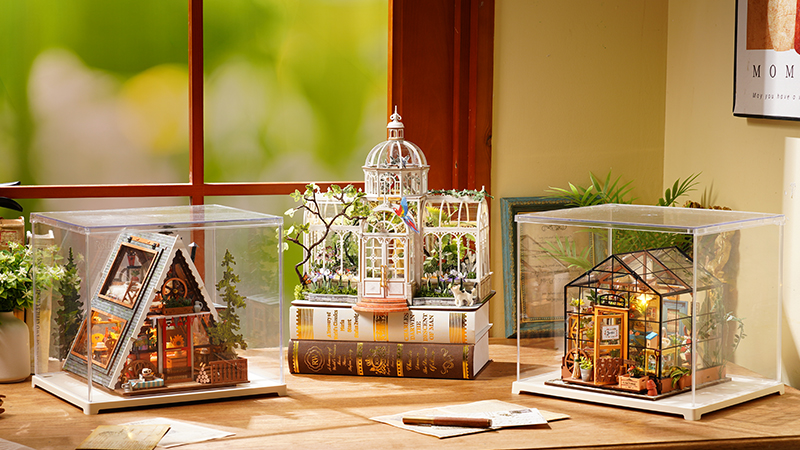
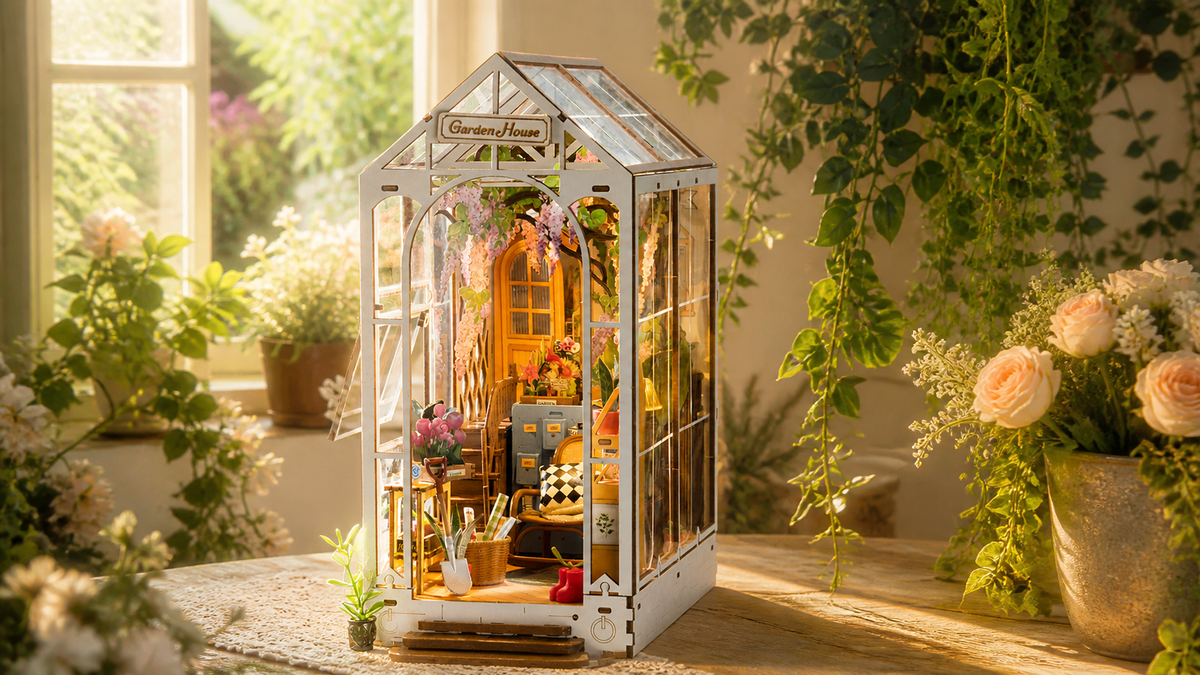
Quick Answer: Rolife Holiday Garden House TGB06 began with a simple design idea: turn the dream of a sunlit European garden house into a miniature secret garden that could live between books. Greenhouse-inspired architecture, flowers, vines, stairs, shelves, warm LED light, and a hands-on build come together to make it more than bookshelf decoration—it is a garden world the builder creates.
Some bookshelf objects are meant to be seen at a glance. Holiday Garden House was designed to make you pause, lean closer, and look through the doorway. From the front, it appears to be a bright garden house filled with flowers. Placed between books, it becomes something more imaginative: a hidden place that seems to continue beyond the shelf.
The Inspiration Behind Holiday Garden House
The starting point was a familiar daydream: a private sunroom filled with morning light, climbing flowers, favorite objects, and a quiet place to read. We were drawn to the romance of European garden houses—their transparent walls, graceful frames, and sense that the garden continues indoors.
But TGB06 was never intended to represent a real indoor garden or a substitute for living plants. The design question was different: how could the atmosphere of a dream garden house become a story-sized scene for a bookshelf?
That question led us to the idea of a secret garden between books. A bookshelf already holds entrances to imagined worlds. By placing a narrow, illuminated garden house among the book spines, we could give that metaphor a physical form: one small opening into a place that feels hidden, warm, and alive with detail.
From Garden House Dreams to a Book Nook World
A full garden house is open and spacious. A book nook is narrow, framed, and viewed mainly from the front. Translating one into the other meant choosing details that could create depth without making the scene feel crowded.
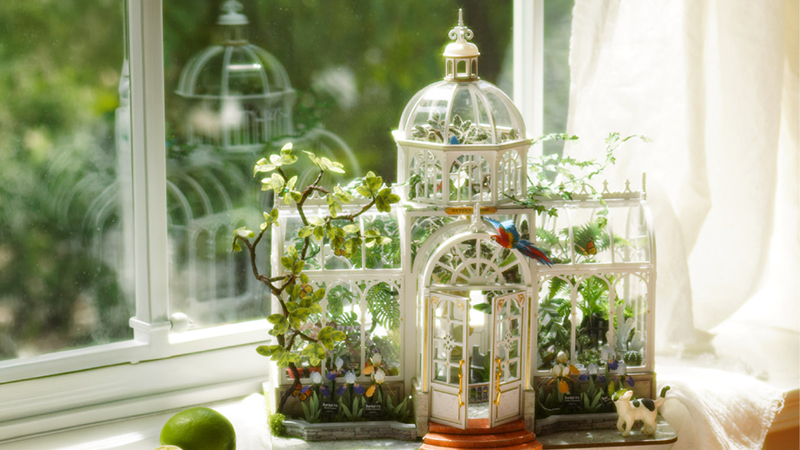
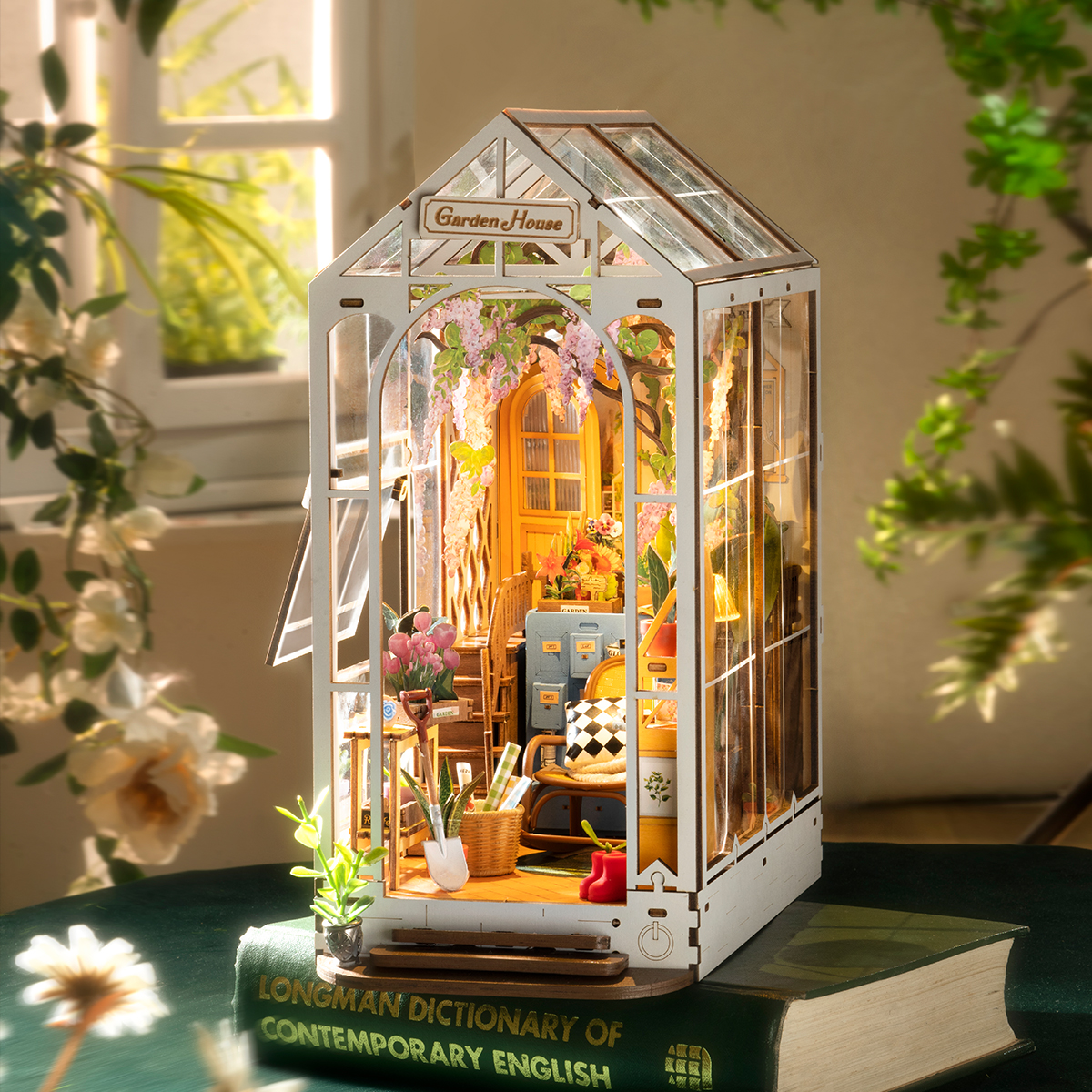
The greenhouse-inspired shell establishes the setting immediately. Transparent PET elements allow light and color to travel through the structure, while the taller vertical shape suits the space between books. Inside, the stairs guide the eye upward, the shelves suggest daily life, and the vines connect the architecture to the garden.
The scene was composed as a path for the viewer’s attention:
- Enter through the garden-house opening. The structure frames the scene like the first page of a story.
- Follow the stairs and shelves. Their vertical movement makes the compact interior feel deeper and more lived in.
- Notice the flowers and vines. These details soften the framework and make the garden appear to be growing through the space.
- Return after dark. Warm LED light reveals another mood and draws the eye back into the miniature world.
Key Takeaway: TGB06 was not designed by shrinking a garden house evenly. It was designed by selecting the architectural and botanical details that tell the clearest story inside a bookshelf-sized frame.
Designing Details That Bring the Garden to Life
Miniature scenes feel convincing when their details appear to belong to the same world. For Holiday Garden House, each major feature was chosen to contribute both visually and narratively.
| Design Detail | Visual Role | Story It Suggests |
|---|---|---|
| Flowers | Add color and softness | The garden is cared for and in bloom. |
| Stairs | Create height and depth | There is more to discover beyond the first view. |
| Shelves | Organize tiny objects | Someone uses and belongs in this garden house. |
| Vines | Connect plants with architecture | Nature is gradually weaving through the space. |
| Greenhouse frames | Define the European garden-house setting | The scene sits between indoors and outdoors. |
| Warm LED light | Add atmosphere after dark | The secret garden remains welcoming when the room grows quiet. |
Flowers as more than decoration
The flowers provide the most immediate botanical signal, but their role is not simply to fill empty space. Their scale, placement, and color help lead the viewer from the front of the book nook toward the smaller details inside.
A staircase that expands the scene
The staircase introduces movement into a narrow interior. It gives the eye a route to follow and suggests another level, making the garden house feel like a place rather than a flat display.
Shelves that imply a life inside
Tiny shelves and the objects arranged on them give the garden house a human rhythm. They suggest collecting, arranging, reading, and caring for the space. This is an important part of miniature storytelling: architecture creates the setting, but everyday objects make it feel inhabited.
Vines that soften the structure
Greenhouse frames are geometric by nature. Vines interrupt those straight lines, linking the floral elements with the architecture and giving the impression that the garden is slowly claiming the house as its own.
A More Enjoyable Building Experience
The story of Holiday Garden House is not complete when the design is drawn. It is completed when a builder assembles the scene, notices how the parts connect, and sees the light come on for the first time.
TGB06 combines PET elements, injection-molded parts, cardstock, and wooden boards. Each material has a different job: transparent pieces create the greenhouse effect, molded details add dimension, printed cardstock carries fine visual information, and wooden boards provide structure.
We also used card-slot assembly to make the construction sequence clearer and reduce unnecessary glue use. This does not mean every part of the project is glue-free. Small decorative components still reward careful handling, and builders should prepare a clean workspace where pieces can be sorted without being lost.
The estimated assembly time is about five hours. That makes the build substantial enough to feel like a creative project, while still fitting into a focused afternoon or a few shorter sessions. The pace will vary, especially for builders who enjoy refining the flowers and other small DIY details.
What the builder experiences
- Structure first: The garden-house framework establishes the shape and viewing angle.
- Layering next: Stairs, shelves, plants, and furnishings gradually create depth.
- Detail work: Smaller botanical pieces give the scene its personality.
- The lighting moment: Warm illumination brings the separate components together as one world.
That progression matters. The builder does not simply attach decorations to a box; they watch an empty framework become a secret garden.
Why This Book Nook Feels Different
Holiday Garden House is not only a decorative object with a botanical theme. Its identity comes from the relationship between three things: a bookshelf, a hidden garden story, and the act of building.
On the shelf, the narrow structure becomes a passage between books. Inside the scene, greenhouse architecture and botanical details suggest a private world. During assembly, the maker becomes part of that story by deciding how carefully each flower, vine, shelf, and tiny object comes together.
This is also why the finished piece can feel personal even when builders follow the same instructions. One person may remember the staircase that finally clicked into place. Another may notice the flowers first. Someone else may wait until evening to switch on the light and see how the scene changes.
If you are thinking about how the finished book nook can live among your collection, our guide to creating a secret garden bookshelf with book nooks and botanical decor offers a practical styling sequence.
For a broader look at the design language behind this miniature, visit The Art of Botanical Book Nooks, our guide to secret gardens, greenhouse details, and storytelling between books.
For us, that is what makes TGB06 different: it is not simply a miniature garden to display. It is a secret garden you build, illuminate, and place between the stories you already love.
Explore Rolife Holiday Garden House TGB06 and decide where your own secret garden could appear on the shelf.
Featured Book Nook
Rolife Holiday Garden House TGB06
$46.99
Build a greenhouse-inspired secret garden with flowers, stairs, shelves, and warm LED light, then display it between your favorite books.
Holiday Garden House TGB06 FAQs
What inspired Rolife Holiday Garden House TGB06?
It was inspired by the dream of a sunlit European garden house and the idea of discovering a hidden secret garden between books.
What materials are used in TGB06?
The kit combines PET elements, injection-molded parts, cardstock, and wooden boards. These materials support transparency, dimensional detail, printed decoration, and structure.
How long does TGB06 take to assemble?
The estimated assembly time is about five hours. Actual time varies with experience, pace, and the amount of attention given to small decorative details.
Does TGB06 require glue?
The card-slot construction reduces unnecessary glue use, but the project should not be treated as completely glue-free. Some small decorative parts may still require careful attachment.
What makes TGB06 different from a regular bookshelf ornament?
It combines an illuminated miniature world with a hands-on building experience. Placed between books, its narrow greenhouse scene creates the impression of a secret garden continuing beyond the shelf.